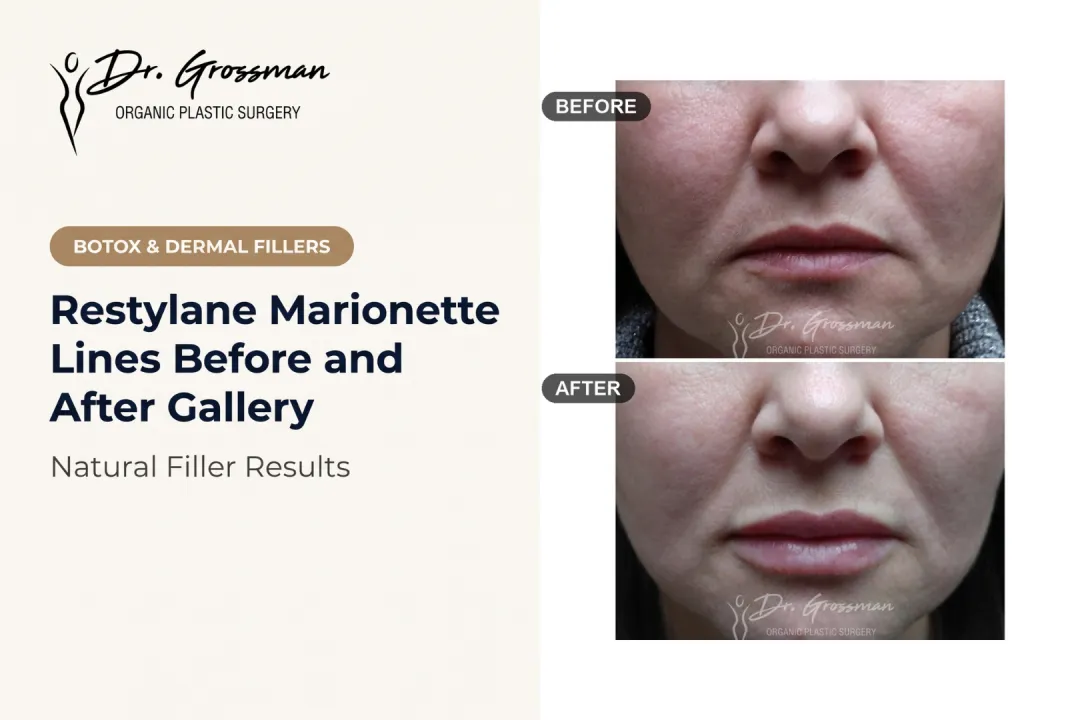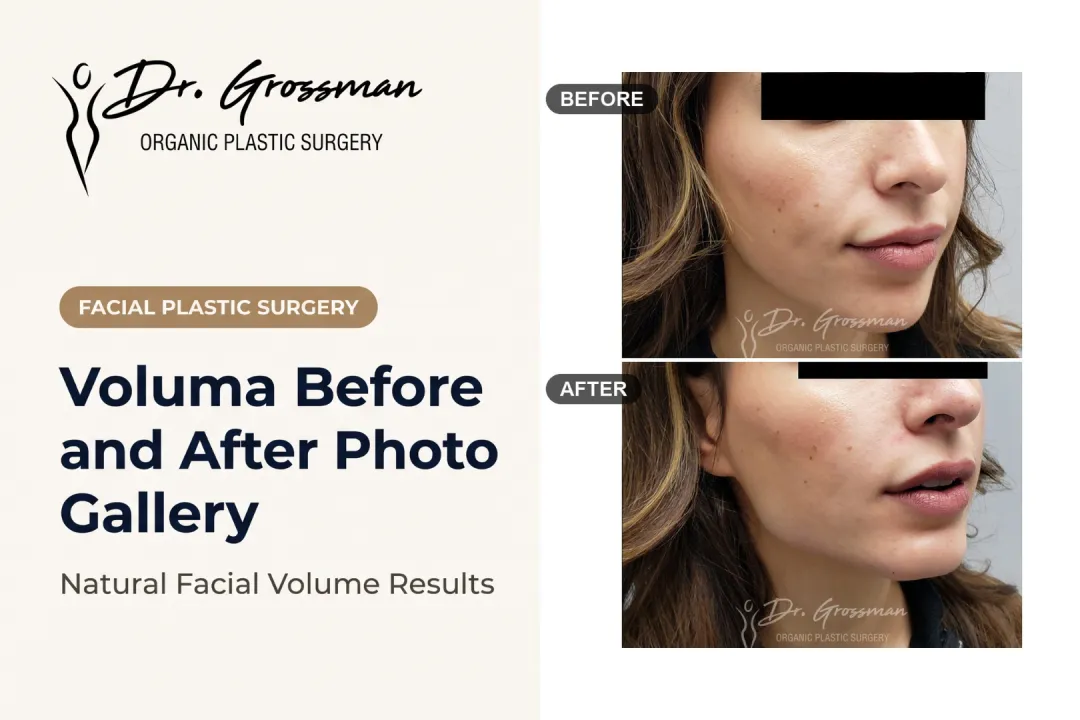

The real question is how to soften the folds without ending up with a stiff, heavy, or overfilled mouth area. This article compares the most relevant Restylane options, explains direct versus indirect treatment, and covers what an injector should assess before recommending a product, including how Dr. Leonard Grossman, who has used Restylane since 1995, approaches the lower face.
Key Takeaways
- Defyne suits moderate-to-deep folds that need support while keeping movement natural.
- Refyne fits milder folds where flexibility and subtle correction matter most.
- Lyft and Contour support the cheeks or midface rather than filling the crease itself.
- Product choice depends on anatomy, skin quality, fold depth, goals, labeling, and injector skill.
Overview of Restylane Fillers for Marionette Lines in the United States
What marionette lines are and why they form
Marionette lines are static folds that run from the corners of the mouth toward the chin. Nasolabial folds are different: they run from the nose toward the mouth corners. The two terms are not interchangeable.
A peer-reviewed anatomical review lists several contributors:
- Bone resorption in the upper and lower jaw
- Gravity pulling tissue downward
- Changes in lower-lip fat compartments
- Aging of skin, collagen, and subcutaneous fat
- Depressor anguli oris muscle activity at the mouth corners
Collagen decline starts as early as the mid-20s, so by the 40s thinner skin and lost support are common. Dr. Grossman puts the emphasis on that loss of volume: in his view the "deflation effect", more than gravity, is what makes the lower face look tired.
Restylane and US labeling
Restylane is a family of hyaluronic acid (HA) gel fillers. Galderma states the family is for patients over age 21. Neither the official product page nor current FDA labeling names marionette lines as a Restylane indication.
Defyne and Refyne are labeled for facial folds such as nasolabial folds, which are anatomically distinct. Using a product for marionette lines is clinical judgment, not a labeled indication.
Confirm current indications with your injector or the FDA labeling before treatment.
The products below are not a universal ranking. They represent different use cases that a clinician weighs against your anatomy and the correction you want. Dr. Grossman's own pages describe Restylane, Restylane Lyft, and Restylane Sub-Q, so ask which formulation he would choose for you and why.

Best Restylane Dermal Fillers for Marionette Lines
Criteria that matter include:
- Level of support
- Flexibility during expression
- Direct versus indirect correction
- Labeling
- Expected duration
- Lower-face balance
A 2024 rheology study measured G' (gel firmness) at 0.1 Hz:
| Product | G' |
|---|---|
| Refyne | 70 Pa |
| Defyne | 271 Pa |
| Restylane | 701 Pa |
| Lyft | 799 Pa |
These are laboratory measurements, not clinical rankings of marionette-line results.
Restylane Defyne
Defyne is an HA filler (20 mg/mL HA, 3 mg/mL lidocaine) that Galderma describes as using XpresHAn technology. Its US labeling covers moderate-to-severe deep facial folds such as nasolabial folds, plus chin augmentation for mild-to-moderate chin retrusion.
An injector may consider it for moderate-to-deeper marionette folds or lower-face volume loss, after examining the cheeks, mouth corners, chin, jawline, and skin laxity.
- Best suited for: patients who need more support than a soft, superficial filler offers.
- Characteristics: intermediate firmness with flexibility, placed in the mid-to-deep dermis for folds, which suits a mobile area around the mouth.
- Qualification: it is not labeled specifically for marionette lines. Duration and results vary.
In a randomized postmarketing study, 100% of participants showed overall aesthetic improvement at Week 9 after combined chin, nasolabial, and marionette treatment. That result is composite, not marionette-only.
Restylane Refyne
Refyne is the most flexible of the group (20 mg/mL HA, 3 mg/mL lidocaine). Its US indication covers moderate-to-severe facial folds such as nasolabial folds. It does not name lip augmentation or perioral lines.
Its softness suits milder or moderate marionette lines where the goal is subtle softening, not substantial lifting.
- Best suited for: conservative correction and natural movement in an expressive area.
- Characteristics: softer than Defyne, with less lifting capacity. That is a lab-based difference, not a guaranteed outcome.
- Qualification: it may not support significant laxity or deep structural folds, and adjacent areas may need treatment too.
Restylane Lyft
Lyft (NASHA technology, 20 mg/mL HA, 0.3% lidocaine) is the firmest option here. Its US labeling covers facial folds such as nasolabial folds, cheek augmentation and age-related midface contour deficiency, dorsal-hand volume loss, and chin augmentation.
It may be evaluated when cheek or midface volume loss contributes to downward pull around the mouth. Dr. Grossman's Restylane Lyft page describes it for the cheeks and midface as a non-surgical way to add volume and lift without incisions. It is not automatically injected into every marionette line.
- Best suited for: patients whose assessment shows a need for firmer support or volume in an adjacent area.
- Characteristics: deeper placement, from the deep dermis to the supraperiosteal plane depending on the area, with lift and contour rather than soft fold smoothing.
- Qualification: your injector decides whether direct fold treatment or indirect support is more appropriate.
Restylane and Restylane-L
The original Restylane is a non-animal stabilized HA filler at 20 mg/mL. Restylane-L adds 0.3% lidocaine. Both are labeled for moderate-to-severe facial wrinkles and folds such as nasolabial folds, plus submucosal lip augmentation. Check current US availability and naming with your provider.
Newer is not automatically better, and classic is not automatically inferior. Restylane's lab firmness (701 Pa) sits well above Defyne and Refyne.
- Best suited for: patients whose anatomy and goals match the product's verified indication.
- Characteristics: firmer than Defyne and Refyne, placed in the mid-to-deep dermis for folds.
- Qualification: choose based on the treatment plan, not brand recognition or published longevity claims.
Restylane Contour for Adjacent Cheek or Midface Support
Contour (XpresHAn, 20 mg/mL HA, 3 mg/mL lidocaine) is labeled for cheek augmentation, midface contour deficiencies, and temple hollowing. It is not a direct marionette-line filler.
Restoring support above the mouth can create a more balanced result than filling the crease alone. Still, the Defyne study did not test a midface-only arm, and cheek-trial endpoints do not prove midface treatment improves marionette lines. For chin support, Dr. Grossman also uses Restylane Sub-Q, which his practice has offered since 2003.
- Best suited for: patients whose exam shows cheek or midface loss contributing to the folds.
- Characteristics: contouring and projection, usually in the subcutaneous or supraperiosteal plane.
- Qualification: not appropriate for everyone. It depends on anatomy, proportions, and goals.

How We Chose the Best Restylane Filler
"Best" means the best match for your anatomy and goals. It does not mean the newest, firmest, longest-lasting, or most expensive product. Two common mistakes: choosing a filler from an online ranking, and asking to fill only the visible crease.
The clinical assessment
A thorough evaluation covers:
- Fold depth and facial movement
- Skin thickness and laxity
- Cheek, midface, chin, and jawline support
- Symmetry and prior filler
- Medical history, allergies, and medications
- How much correction you want
At Dr. Leonard Grossman's practice, he does this assessment himself. He reviews your goals, health, and expectations, then plans each injection point around the cheek, mouth corner and chin, aiming for a refreshed lower face that still looks like you. Treatment uses fine needles, with no incisions or stitches. His practical advice on products: if you find a filler that works great, stick with it; otherwise, don't be afraid to experiment a little.
Technique and provider qualifications
Lower-face vascular anatomy is complex. The facial artery runs through the perioral region and crosses the mandible. The American Society of Plastic Surgeons says filler injection requires specialized training and facial-anatomy knowledge. Dr. Grossman warns that in New York State any physician can legally perform surgery in an office, so ask about:
- Documented plastic surgery residency training at an accredited program
- Experience with lower-face anatomy
- Needle versus cannula choice
- Conservative placement and informed consent
- A plan for managing complications
A 2021 cohort of 1.7 million syringes found vascular occlusion in 1 per 6,410 needle injections versus 1 per 40,882 with cannulas. The data were not Restylane-specific, and neither method eliminates the risk.

Practical expectations
- Timing and recovery: HA filler provides immediate volume, but swelling and bruising can mask the final look for days. At Dr. Grossman's practice the injection sites are mapped first and numbing cream may be applied for comfort; mild swelling, redness or bruising usually settles within a few days, and you can return to regular activities right away.
- Longevity: Varies by formulation, area, and patient. Lyft labeling cites about six months for folds. Published study timelines for other products are not validated estimates for marionette lines.
- Cost: ASPS publishes national HA filler fee statistics, but they are not a Restylane quote and fees vary significantly by location. Your price depends on product, quantity, provider, and whether surrounding areas such as the cheeks or chin are treated, which differs from one face to the next. Dr. Grossman quotes after examining you, and financing options are available.
Safety note
The FDA lists bruising, redness, swelling, pain, tenderness, itching, and rash as common. Restylane labeling says most reactions are mild to moderate and resolve within 1-2 weeks.
Contact your clinician right away for unusual pain, vision changes, white, gray, or blue skin near the injection, or stroke symptoms. Unintended intravascular injection is the main serious risk. Hyaluronidase can reverse HA filler, but reversal is not guaranteed.
Conclusion
Defyne, Refyne, Lyft, Restylane/Restylane-L, and Contour serve different purposes. The right choice depends on whether the main issue is a superficial fold, dynamic movement, volume loss, cheek support, or broader lower-face laxity.
Results that look like you usually come from facial balance and conservative correction, not from chasing a single crease. A good consultation covers:
- Risks and alternatives
- Current labeling
- Expected longevity
- Cost
Dr. Leonard Grossman has more than 30 years of experience in New York City and sees patients at his fully accredited (AAAHC) surgery center at 3039 Emmons Avenue in Brooklyn. Your consultation, treatment, and follow-up all take place there. He will tell you whether Restylane, another filler, or your own fat (the basis of his Organic Plastic Surgery approach) is the better fit for your marionette lines.
Frequently Asked Questions
How much does it cost for fillers in marionette lines?
Cost varies significantly by location and by patient: product, syringe count, injector qualifications, and whether adjacent areas are treated all change the total, so a national average isn't a useful Restylane quote. Dr. Grossman gives you a personalized quote at consultation.
How long do fillers last for marionette lines?
It depends on the formulation, injection depth, facial movement, metabolism, and maintenance schedule. Dr. Grossman's practice cites 6 to 18 months for Restylane in general, but no validated marionette-line duration exists, so expect an estimate, not a promise.
How long will Restylane Defyne last?
The FDA nasolabial fold study reported meaningful improvement through one year. That's a study estimate for a different area, and individual results vary.
What is the best filler for reducing marionette lines?
No single filler is best for everyone. Defyne, Refyne, Lyft, or adjacent cheek support may fit depending on fold depth, movement, volume loss, and goals.
What is Restylane Defyne best for?
It's labeled for moderate-to-severe deep facial folds such as nasolabial folds, and for chin augmentation. Its mix of support and flexibility makes it a candidate in selected lower-face cases.
Are dermal fillers good for marionette lines?
They can soften lines driven partly by volume loss and structural change. They don't stop aging or always erase deep folds, so see an experienced injector with documented plastic surgery training and keep expectations realistic.