
Pricing is where people get stuck. There is no combined national price, and cost varies significantly by geographic location and by the individual patient: anatomy, surgical goals, technique, materials, surgeon fees, anesthesia and facility costs all shape the quote. Published surgeon-fee surveys are not all-in totals, so this guide focuses on what drives the number instead.
This guide covers why pricing varies, itemized costs, what changes your quote, insurance and financing, and what to ask at a consultation. It also explains how Dr. Leonard Grossman, a Brooklyn, NYC plastic surgeon, pairs a lift with added volume from saline implants placed through the navel (TUBA), and where fat transfer, which he has performed since 1995, fits the discussion. It is general information, not medical advice. Only an in-person exam can determine what is right for you.
Key Takeaways
- National surveys report surgeon fees only, excluding anesthesia and facility costs, so they are not a personal estimate.
- No national combined total exists, and a lift with augmentation is not one fixed operation, so its cost cannot be read off a chart.
- Sagging, technique, implant or fat choice, anesthesia, facility, and revision status drive the quote.
- The cheapest quote is not the best value; compare inclusions, safety and follow-up.
How Much Does Breast Lift and Augmentation Cost? (Pricing Overview)
The ASPS 2024 statistics report average surgeon fees from surveyed members across varied locations and practice settings, but they exclude anesthesia and facility fees and vary by region. The table below shows what actually changes a combined quote.
| Component | What makes it vary |
|---|---|
| Breast lift alone | Degree of sagging, nipple position, skin quality and incision pattern |
| Breast augmentation with implants | Implant type, size and placement, and whether it goes in through the navel or the lift incisions |
| Fat-grafting augmentation (no implants) | Donor areas, volume of fat, and whether a second session is needed |

National surgeon-fee statistics exclude anesthesia, operating-room or facility expenses and related costs. They list no combined lift-plus-implant fee and are not a personal quote.
A Simple Tiered View
Price alone does not equal quality. Still, quotes tend to fall into rough tiers:
- Straightforward plans: a modest lift with implants and a clearly limited scope
- Mid-range plans: a lift pattern chosen for your anatomy, implants, an accredited facility, and routine aftercare
- Complex plans: extensive skin removal, asymmetry correction, revision surgery, premium implants, fat grafting, or longer operating time
Ask exactly what facility, anesthesia, and follow-up each quote represents.
Breast Lift Alone vs. Augmentation Alone
A lift changes position and shape. Augmentation mainly changes volume and fullness. Your goals decide which one you need, and therefore your budget.
Those differences also mean you should not compare a lift-only surgeon fee with a combined all-in total. They measure different things.
Breast Lift With Implants
ASPS notes that the two procedures may happen in one operation or as separate operations. One session shares anesthesia and a facility stay. It still costs more than either procedure alone because of added planning, materials and operative complexity.
Implant type, size, profile, placement and manufacturer can all shift the quote. Choose based on anatomy, goals and safety, not on a brand.
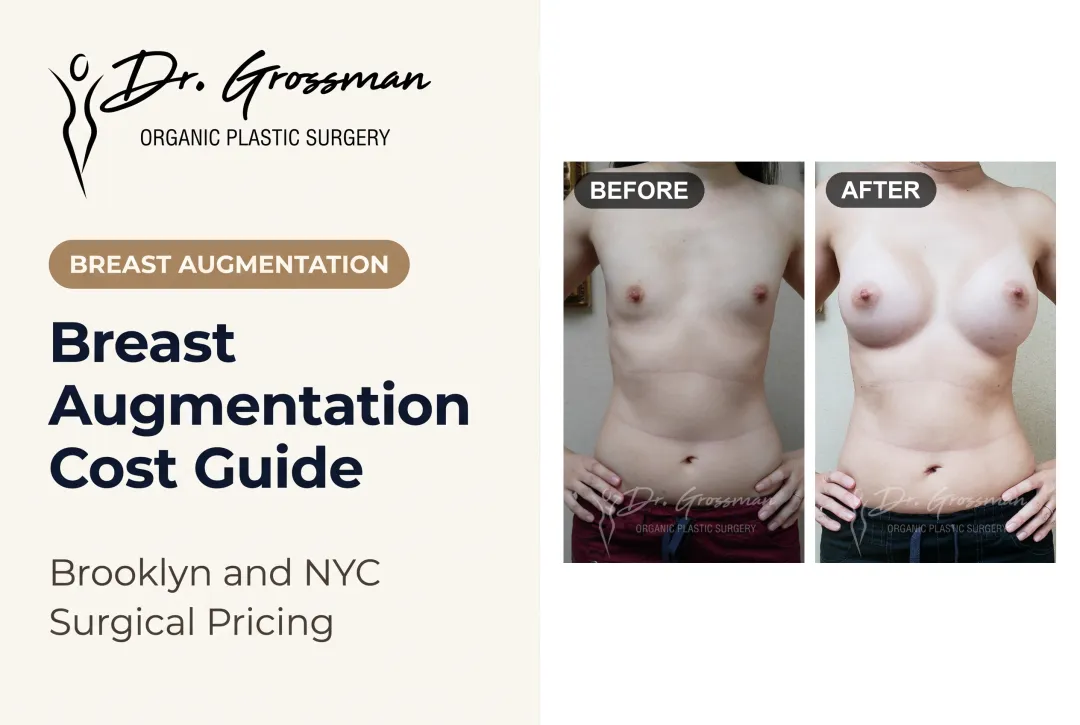
Dr. Grossman's plan depends on how much lift you need. According to his practice, patients who want a small-to-moderate lift along with augmentation can often have both through TUBA, which places a saline implant through a small incision inside the navel. Patients who need a larger lift can usually have their implants placed through the lift incisions. Those are two very different operations sharing one name: the first leaves no incision on the breast for the implant, the second uses the lift incisions for both steps. Your anatomy, not the procedure name, decides which one you need and what it costs.
Breast Lift With Fat Transfer
ASPS publishes a national surgeon-fee statistic for fat-grafting augmentation, but no donor-site liposuction fee. Treat any published figure as incomplete, not as a total.
Budget depends on:
- Available donor fat and the number of treatment areas
- Fat-processing methods
- Volume transferred
- Whether staged treatment is recommended
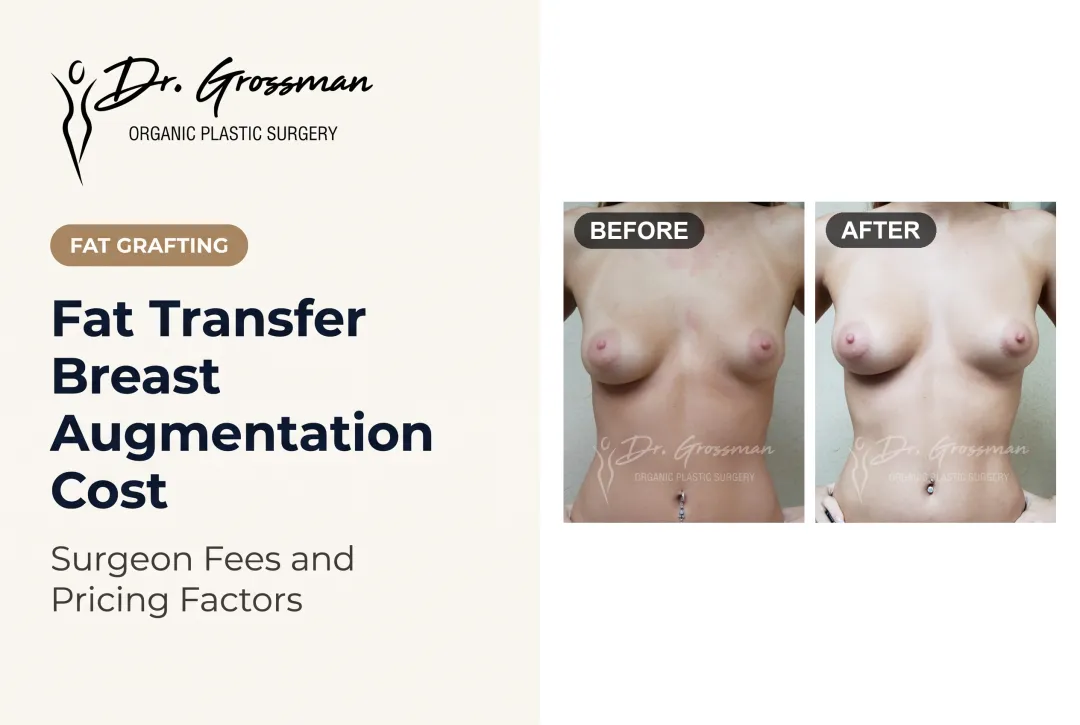
Dr. Leonard Grossman, who has performed fat transfer to the breasts since 1995, plans for about 1 to 1.5 cup sizes per procedure. The fat is harvested with thin cannulas, then washed, centrifuged and stabilized before it is layered into the breast, and larger goals may take a second session. This is his Organic Plastic Surgery approach: your own tissue in place of an implant. Some transferred fat may not remain, and touch-ups may be needed.
What the Advertised Range May Include or Exclude
Ask whether the quote covers:
- Surgeon's fee
- Anesthesia provider
- Accredited facility
- Implants or fat-transfer work
- Pre-operative testing
- Medications and surgical garments
- Follow-up visits (a full quote should cover the first year)
- Revision-related policies
A national average is not your quote. Request a written, itemized estimate after an exam.
Key Factors That Affect Breast Lift and Augmentation Cost
Price reflects medical complexity, surgical resources, materials, overhead and scope of care, not just hours in the operating room.
Degree of Sagging and Lift Technique
Excess skin, nipple position, breast shape, asymmetry and skin elasticity shape the surgical plan. ASPS describes three incision patterns:
- Periareolar: around the areola
- Vertical: around the areola and down to the breast crease
- Anchor: adds an incision along the crease
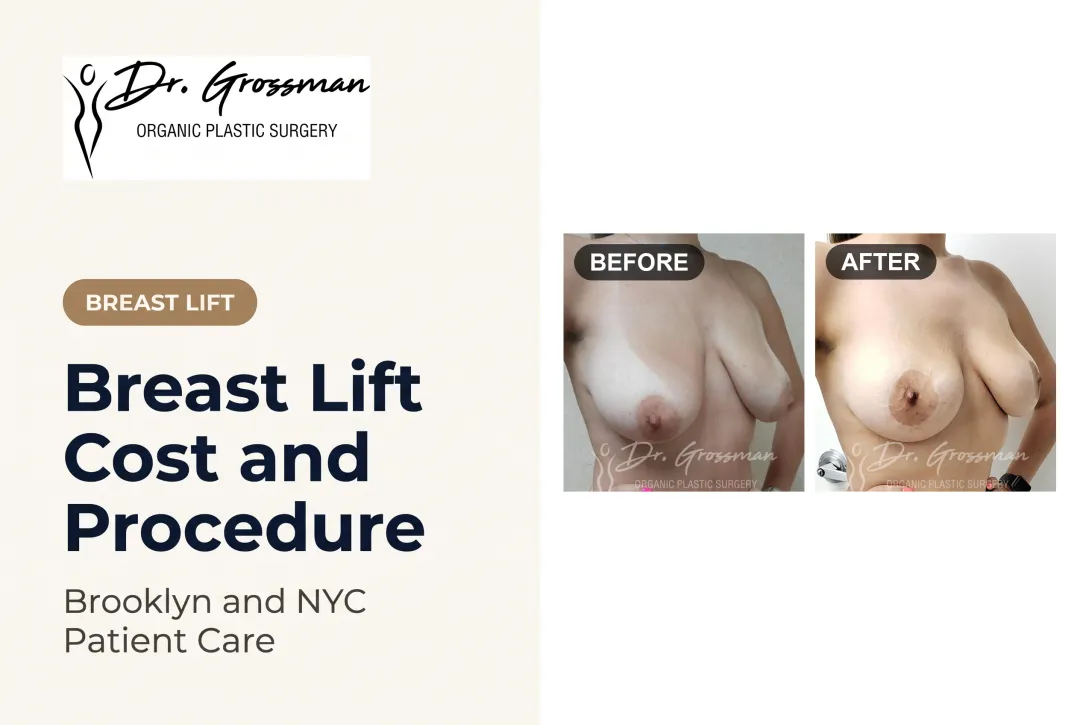
Selection depends on breast size and shape, areola position, degree of sagging and skin quality. No technique is universally cheaper or better. The lift Dr. Grossman's practice describes in detail is the periareolar lift, with an incision only around the border of the areola that avoids a vertical or anchor-shaped scar; it suits mild to moderate sagging. Your incision pattern is chosen at consultation.
Implant Selection and Augmentation Plan
Saline versus silicone, size, profile and placement all affect material and surgical costs. FDA age requirements apply to both saline and silicone implants. Silicone-gel implants also need periodic imaging: the FDA recommends ultrasound or MRI to check for silent rupture.

Let anatomy, goals and your surgeon's advice lead, not price. His practice considers saline likely to be the better choice for many patients, given its much lower capsular contracture risk, and it is the implant he uses with TUBA.
Fat Transfer and Donor-Site Requirements
Fat transfer adds harvesting, processing, contouring and injection. Liposuction of one or more donor areas raises the cost. Breast tissue density and skin elasticity limit how much fat can go in.
Candidacy, donor fat and the chance of a second session should be discussed at consultation. No volume is guaranteed.
Surgeon, Anesthesia, and Facility Fees
Surgeon experience with breast procedures, the anesthesia provider and type, operating room, nursing, emergency readiness and accreditation all influence the quote. ASPS names AAAASF, AAAHC and the Joint Commission as accrediting bodies.
Verify credentials yourself: ask for documentation that the surgeon completed plastic surgery residency training at an accredited program. Dr. Grossman completed a fully accredited plastic surgery residency at Scott & White Memorial Hospital in Texas in 1995 and operates in his own fully accredited (AAAHC) surgery center in Brooklyn. There, the practice standard is local anesthesia with advanced IV sedation rather than general anesthesia; he confirms the exact plan with you beforehand.
Geographic Location and Case Complexity
Surgeon fees vary with experience, procedure type and location. National ranges may not match a specific city or practice. Other cost-raising factors:
- Revision surgery or prior implants
- Significant asymmetry
- Poor skin quality
- Medical conditions requiring extra clearance
- Combining breast surgery with other procedures
Breast Lift and Augmentation Cost Breakdown: Lower-Cost vs Higher-Cost Plans
The advertised surgical fee is rarely the full investment. Review an itemized estimate, not a headline number.
Surgeon's Professional Fee
This fee covers planning, the procedure and professional services. Confirm whether consultations, postoperative care and revisions are included.
Facility and Anesthesia
Operating room, nursing, equipment, anesthesia and recovery charges may be billed separately or bundled. Ask who provides anesthesia and what the facility fee covers. Because Dr. Grossman operates in an outpatient center rather than a hospital, there is no hospital stay to pay for, and you go home the same day.
Implants, Fat Transfer, and Supplies
Expect line items for implant or fat-processing charges, garments, dressings and any drains. Ask which of these each quote includes. Dr. Grossman does not use drains with TUBA, and his breast procedures are designed without compression garments, narcotics or special pillows.
Pre- and Post-Operative Care
These items may appear as separate charges:
- Medical clearance, testing or imaging
- Prescriptions
- Postoperative bras or compression garments, if a practice requires them (Dr. Grossman's breast protocol does not)
- Follow-up visits
Future and Contingency Costs
The FDA says implants are not lifetime devices, and the chance of removal or more surgery rises over time. Possible costs include implant imaging, replacement, removal, revision and scar care. None of these is inevitable.

Manufacturer warranties differ. Some offer replacement for qualifying rupture and capped financial assistance under specific terms, but they do not cover all surgical costs. Read the terms.
Lower-Cost vs Higher-Cost Quotes
A lower quote may reflect a simpler case, fewer bundled services, a different facility or anesthesia arrangement, or regional pricing. A higher one may reflect complexity, materials, expertise, facility standards or fuller follow-up.
Compare quotes on:
- Surgeon credentials and breast-surgery experience
- Facility accreditation and anesthesia provider
- What is included and excluded
- Cancellation terms
- Follow-up access
- Revision policy
How to Estimate the Right Budget and What Patients Often Miss
Budget for your treatment plan, safety, recovery and long-term expectations, not only the procedure fee.
Build an Itemized Personal Budget
Include:
- The quoted surgical fee
- Consultation or testing fees
- Medications and recovery supplies
- Transportation and parking
- Time away from work
- Childcare or caregiver help
- A reserve for extra postoperative needs
Ask each practice for a written estimate separating one-time surgical costs from possible future or optional expenses.
Insurance, Financing, and Payment Planning
ASPS says most health plans do not cover cosmetic breast augmentation or later revision surgery, and the Aesthetic Society describes lifts as elective cosmetic surgery. Reconstruction after mastectomy is different under federal law, but it is not a mandate for elective procedures. Confirm benefits, exclusions and preauthorization with your insurer.
Financing is optional. The CFPB's 2023 report warns that deferred-interest promotions often run 6-18 months, and unpaid balances can trigger retroactive interest. Compare rates, deposits, cancellation terms and total repayment, not just the monthly payment.
Costs and Questions People Commonly Miss
- Pregnancy can stretch skin and reduce lift results; significant weight loss should be discussed beforehand
- Breastfeeding may be harder after a lift
- Silicone-implant imaging may not be covered by insurance
- Time off work: about a week for many jobs, with activity restrictions for roughly two weeks. Recovery with Dr. Grossman tends to be lighter: surgery is outpatient, most TUBA patients return to work the next day, and his practice's blog notes that a periareolar lift can even be done under local anesthesia with Pro-Nox (laughing gas) as a lunchtime surgery, after which the patient can drive home or back to work
- Combining or delaying procedures may not be medically suitable for every patient
If you're considering care with Dr. Leonard Grossman, request a private consultation at his Brooklyn practice at 3039 Emmons Ave. He examines you, takes photographs and measurements, tells you honestly whether a lift with TUBA, a lift with implants placed through the lift incisions, or fat transfer as the volume option fits your anatomy, and gives you a detailed estimate. Ask the office about financing through Cherry or Prosper Healthcare Lending.
Conclusion
Costs vary depending on lift technique, implant or fat-transfer plan, surgeon, anesthesia, facility, geography, and your anatomy. National figures are only a starting point.
A sound decision balances transparent pricing, verified credentials, facility standards, realistic expectations, and thorough follow-up. Get an itemized written quote and talk with an experienced plastic surgeon before deciding, because corrective surgery costs far more than a combined procedure done well the first time.
Frequently Asked Questions
What is the average cost for a breast lift and augmentation?
No combined national total is published, and the national surgeon-fee statistics that exist exclude anesthesia and facility costs. Cost varies significantly by location and by how much lift, volume and correction your anatomy calls for, so an exam is needed for an accurate estimate.
What is the average cost of a fat transfer breast augmentation?
Published surgeon-fee statistics leave out donor-site liposuction, anesthesia and facility costs. The number of donor areas, the volume of fat, candidacy and staged treatment all change the total.
Will insurance pay for a breast lift?
Cosmetic lifts are generally not covered. Medically necessary or reconstructive situations may be treated differently, so confirm with your plan.
Can you get a breast lift and augmentation at the same time?
Often, yes, for suitable candidates. With Dr. Grossman, a small-to-moderate lift can often be combined with TUBA saline implants, and whether fat transfer can add volume alongside a lift is assessed at consultation when you have donor fat to spare. Anatomy, health, goals and safety decide whether one operation or two is better.
Is it cheaper to get breast implants or a breast lift?
Either can cost more depending on complexity and inclusions. They solve different problems: volume versus position and shape.
Is a breast lift worth the money?
That depends on your goals, expected benefits, risks, longevity, recovery and financial priorities. Dr. Grossman's lift aims to keep the breast's original shape and volume while raising the nipple and areola, with minimal scarring and a natural-looking result. Price alone does not answer it.