
Quotes shift with the hernia type and size, how much skin and muscle needs correcting, surgeon, facility and anesthesia fees, mesh, insurance benefits, and your local market.
No authoritative published U.S. price exists for the combined operation. This guide explains why published component figures mislead and what a quote should include, and shows how to compare estimates responsibly. It also describes how Dr. Leonard Grossman, a Brooklyn, NYC plastic surgeon, folds hernia repair into his drainless tummy tuck.
Key Takeaways
- No reliable all-in national price exists, so be wary of any fixed "package" figure.
- Hernia repair may qualify for insurance coverage; the cosmetic tummy tuck usually does not.
- Hernia size, recurrence, mesh, and extent of skin removal can raise the total.
- Cheapest quote is not automatically the best value.
- Dr. Grossman's gallery includes a drainless tummy tuck with hernia repair, performed at his fully accredited Brooklyn surgery center.
How Much Does a Tummy Tuck with Hernia Repair Cost?
There is no universal price because the phrase covers very different operations. At one end is a small umbilical repair done during a standard abdominoplasty. At the other is complex abdominal-wall reconstruction with mesh or a co-surgeon.
Misreading that range causes problems:
- Underbudgeting for the full operation
- Confusion over what insurance will pay
- Surprise charges for anesthesia, facility use, imaging, mesh, garments, medications, and follow-up
Tummy Tuck with Hernia Repair Cost Factors
The American Society of Plastic Surgeons publishes national surgeon-fee statistics for abdominoplasty in its 2024 fee report, but those cover the surgeon only and vary significantly by region. Anesthesia, facility charges, tests, and prescriptions come on top.
For the hernia side, Medicare publishes patient-payment amounts for initial reducible hernia repairs, and they show how much the hernia itself changes the picture:
| Hernia factor | How it changes the cost |
|---|---|
| Defect size (under 3 cm, 3-10 cm, over 10 cm) | Larger defects take longer and more often need mesh |
| Setting (surgery center vs. hospital outpatient) | Facility payments differ by setting |
| Initial vs. recurrent hernia | Recurrent repairs are more complex and priced separately |
Medicare figures are patient payments, not total prices or cash quotes, and they exclude physician professional fees. Don't add them to a surgeon fee and call the sum a quote; they measure different things.

Here is how the three common scenarios differ in practice. Published dollar ranges for each scenario are hard to find, so ask for individualized quotes.
- Straightforward: a standard tummy tuck with a small, uncomplicated umbilical or ventral hernia repair, often by suture.
- More involved: broader skin and muscle correction, a larger defect, mesh, or added contouring. Each pushes the quote up.
- Complex: recurrent or incisional hernia, component separation, extended abdominoplasty, overnight monitoring, or multiple specialists. These cases need a fully individualized quote.
Cost Breakdown
A combined quote may contain these lines:
- Surgeon fees: reflect the difficulty of both procedures and whether a plastic surgeon, general surgeon, or team is involved.
- Facility and anesthesia: operating-room time, anesthesia duration, recovery monitoring, and possible overnight care.
- Hernia-specific items: imaging, mesh or other reinforcement, and any added reconstruction.
- Before and after: consultations, clearance, lab work, prescriptions, garments, follow-up visits, travel, and time off work.
Budget for the possibility of additional treatment or revisions, without assuming problems will occur. No surgeon can promise a complication-free result.
Some of these lines look different at Dr. Grossman's practice. His tummy tuck uses no drain tubes, compression garments aren't required (some patients choose an abdominal binder for comfort), and his procedures are outpatient, so you go home the same day.
Key Factors That Affect the Cost of a Tummy Tuck with Hernia Repair
A fair quote reflects your anatomy, health, goals, and the safest appropriate plan, not a generic procedure label.
Type, Location, and Complexity of the Hernia
Umbilical, epigastric, ventral, incisional, recurrent, and incarcerated hernias call for different approaches. Under 2020 European and Americas guidelines, umbilical and epigastric defects are small (0-1 cm), medium (over 1-4 cm), or large (over 4 cm). Mesh is recommended for most repairs, and suture repair may be considered under 1 cm.
Recurrence adds difficulty. Incisional hernia guidelines report recurrence rates of 23% to 50%, and complications rise after failed repairs. The surgeon, not the price list, must choose the technique.

Extent of the Tummy Tuck
Scope drives operating time and cost:
- Mini: shorter incision, modest skin below the navel
- Full: the whole lower abdomen, muscle repair, navel repositioning
- Extended: adds the flanks and hips
- Fleur-de-lis: for substantial excess skin, often after major weight loss
A full tuck usually costs more than a mini because of the longer incision and more extensive muscle repair. Liposuction, flank contouring, or diastasis repair may be quoted separately. In Dr. Grossman's full tummy tuck, tightening weakened or separated abdominal muscles is part of the operation, not an add-on. When a hernia is repaired in the same operation, there is one recovery instead of two, and he uses techniques to minimize and conceal the abdominal scar. The aim is a firmer, natural-looking abdomen and outstanding results that suit your proportions.
Surgeon, Facility, and Market
Surgeon experience, facility standards, and local demand all affect fees. Higher New York pricing is not proof of better care. New York requires offices performing procedures beyond mild sedation to be accredited, so confirm accreditation, anesthesia staffing, and emergency protocols when comparing quotes. Dr. Grossman's office-based surgery center at 3039 Emmons Avenue is accredited by the AAAHC (Accreditation Association for Ambulatory Health Care).
Mesh, Co-Surgeons, and Operating Time
Mesh, an extra specialist, longer anesthesia, complex closure, and inpatient observation all add cost. A lower quote should never steer you toward an unsuitable repair or a poorly equipped facility.
Patient Health
Smoking, diabetes, unstable weight, prior abdominal surgery, and anemia can delay surgery or add testing. No universal BMI cut-off exists. The American College of Surgeons suggests a BMI under 35 before elective umbilical hernia repair, but that is not a tummy-tuck rule. Confirm criteria with your surgeon, anesthesiologist, and insurer. Dr. Grossman looks for non-smokers in good health at a stable weight; after bariatric surgery, his practice notes that weight takes about 18 to 24 months to stabilize.
Low-Cost vs High-Cost Combined Surgery: What's the Difference?
Low and high cost describe scope, included services, and safety infrastructure. They are not a ranking of surgeon quality.
Procedure Scope
- Lower quote: a smaller tummy tuck, simple hernia repair, limited dissection.
- Higher quote: extended skin removal, mesh, recurrent hernia treatment, or longer monitored recovery.
Included Services
On a low quote, check whether these items are excluded:
- Anesthesia and facility fees
- Mesh, garments, and prescriptions
- Imaging, follow-up, and overnight care
On a high quote, confirm the extras are medically relevant and not just bundled into a bigger headline number.
Safety and Long-Term Value
Comparing non-equivalent quotes is the biggest risk. A cheaper option may lack accreditation, qualified anesthesia care, or a complication plan. Higher cost can be worth it when a reconstructive approach, specialist collaboration, or stronger follow-up fits your case. Dr. Grossman's caution about bargain shopping is blunt: the least expensive surgeon may end up costing you much more.

Evidence also argues for caution. A 2026 systematic review found a median surgical-site occurrence of 20% in combined cases, a 7% to 8% absolute increase over abdominoplasty alone. The studies were varied and do not apply to every patient. Dr. Grossman's own protocol reflects a related concern. His tummy tuck is drainless because, in his view, drain tubes frequently snag, cause discomfort, and may lead to infection.
How to Estimate the Right Budget
Gather this before asking for estimates:
- Hernia type, size, and symptoms
- Prior abdominal surgery
- Desired tummy-tuck extent
- BMI, health history, and smoking status
- Planned facility and your insurance plan
Then request an itemized written estimate that separates:
- Cosmetic charges and medically necessary charges
- Insurance responsibility, deductible, and coinsurance
- Exclusions, deposits, and payment deadlines
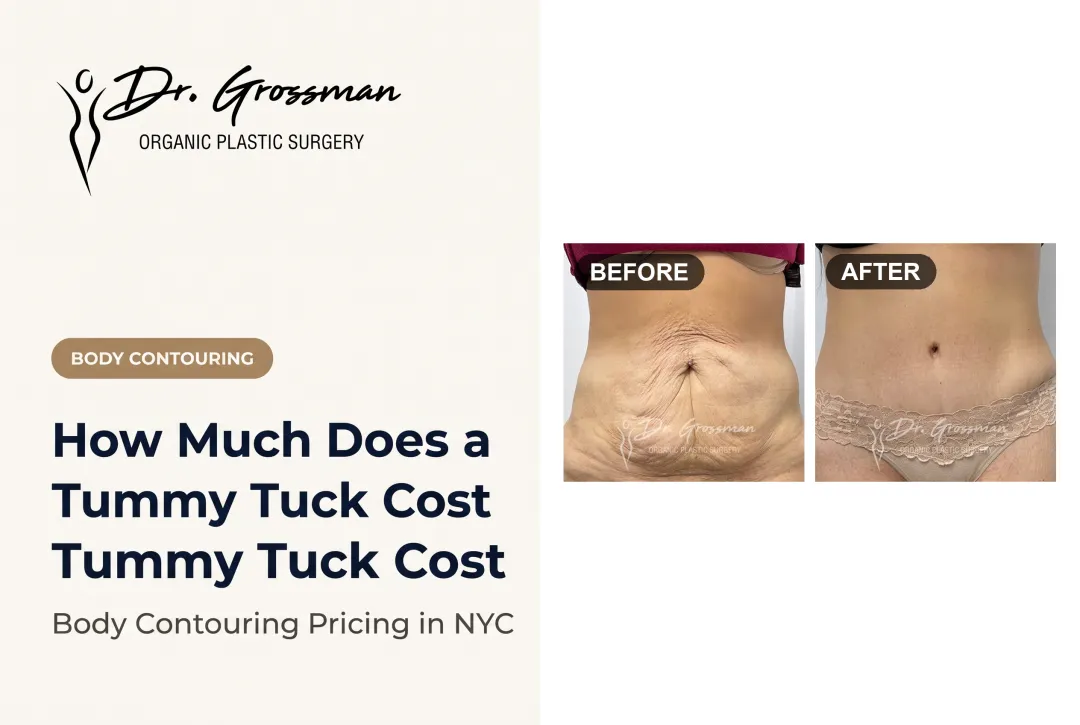
At a consultation with Dr. Leonard Grossman, he examines your abdominal wall, the hernia, and your skin before recommending a plan. His tummy tuck gallery includes a 53-year-old mother of three whose drainless tummy tuck included a hernia repair; she was driving three days later. Surgery is performed under IV propofol sedation with local anesthesia, never general anesthesia, in his fully accredited Brooklyn center, and you receive a transparent, itemized cost breakdown. Ask the office how a combined case is quoted and documented for insurance, and whether your hernia needs a separate specialist. Patient financing is available through Cherry and Prosper Healthcare Lending.
What Most People Miss When It Comes to Cost
- Insurance isn't full payment. A plan may cover medically necessary hernia repair while excluding abdominoplasty; deductibles, coinsurance, prior authorization, and network rules still apply. Aetna, for example, lists qualifying ventral hernia repair as medically necessary and abdominoplasty as cosmetic.
- Shared charges get confusing. No national formula splits anesthesia, operating-room, imaging, mesh, or co-surgeon fees between covered and self-pay portions. Ask how yours will be allocated.
- Recovery costs money. Plan for time off work, childcare, help at home, prescriptions, and follow-up travel; general guidance often cites two to four weeks off and six to eight weeks before heavy lifting. Dr. Grossman's tummy tuck patients go home the same day, walk right away, shower the next day, and usually manage tightness with over-the-counter medication; patients of normal weight drive in about three days on average.
- Don't delay urgent care to shop prices. Seek prompt help for a painful or irreducible bulge, severe abdominal pain, vomiting, fever, or skin discoloration. These can signal incarceration or strangulation.
Conclusion
Costs vary because the surgery combines two goals and a wide range of abdominal-wall complexity. The right budget comes from an itemized quote, verified insurance details, appropriate facility standards, qualified surgical care, and long-term value, not the lowest advertised price.
Frequently Asked Questions
Will insurance cover tummy tuck with hernia repair?
Insurance may cover the medically necessary hernia repair but commonly excludes the cosmetic tummy tuck. Prior authorization, deductibles, coinsurance, and separate billing usually apply.
How much does it cost to get rid of loose stomach skin?
It depends on the procedure: tummy tuck, panniculectomy, or other contouring. Skin amount, muscle repair, facility, anesthesia, and any hernia treatment all shape the estimate.
Can I get a hernia repair and tummy tuck at the same time?
Often yes for appropriate candidates. The decision depends on hernia type, anatomy, health, surgical risk, and coordination between specialists. Dr. Grossman has combined the two in a single drainless operation; whether that suits your hernia is decided at your exam.
What is the BMI cut-off for abdominoplasty?
No single cut-off exists. Criteria vary by surgeon, facility, anesthesiologist, and insurer, so prioritize stable weight and an individual safety assessment.
Is loose skin removal a tummy tuck?
Not always. A panniculectomy mainly removes the hanging lower-abdominal apron. A tummy tuck can also tighten muscles, reposition the navel, and contour more broadly.
What is the new alternative to a tummy tuck?
Options include non-surgical skin tightening, liposuction, panniculectomy, and mini tummy tucks. They may not remove substantial loose skin or repair a hernia. For mild to moderate laxity without a hernia, Dr. Grossman also offers Renuvion (J-Plasma) skin tightening, often combined with liposuction.