
Cost varies significantly by geographic location and by the individual patient's anatomy and needs. Surgeon expertise, nasal anatomy, anesthesia, facility, and the level of aftercare all move the total. Many patients compare headline numbers online without knowing what those numbers include.
This guide separates national benchmarks from New York-area context, breaks down the full cost, flags hidden expenses, and shows how to get a realistic personalized estimate. Along the way, it explains how Dr. Leonard Grossman plans surgical and non-surgical nose reshaping.
Key Takeaways
- National surgeon-fee statistics cover fees only and can't predict an all-in total
- Primary, revision, functional, combined, and nonsurgical options involve different steps and price differently
- Complexity, experience, facility, anesthesia, location, and insurance shape the quote
- The lowest quote is not automatically the best value
- Dr. Grossman's plan may be open or closed rhinoplasty or his non-surgical Nose Job in a Bottle, each quoted individually, with a recovery designed around comfort and discreet incisions
How Much Does Rhinoplasty Cost in 2026?
Rhinoplasty has no fixed price. Online ranges can't predict your cost; a real number only comes after a surgeon evaluates your anatomy, goals, medical history, and any breathing concerns.
What a 2026 Rhinoplasty Price Figure Leaves Out
The most cited national data comes from the ASPS 2024 statistics, which report average surgeon fees. That is an aggregate of averages reported by surveyed ASPS member surgeons, not an all-inclusive bill, and it blends simple and complex noses from every region.
A second ASPS average also circulates. It carries no stated data year and, according to the ASPS cost page, excludes anesthesia, operating-room facilities, and related expenses. Treat any such figure as partial at best.
Authoritative 2026 all-in ranges for primary, revision, or functional cases are hard to find, as is a methodologically comparable New York City benchmark. Individual quotes are the norm. Mount Sinai, for example, gives individualized expected costs rather than a published range. Any NYC figure you see online should not be read as pricing for Dr. Grossman's practice.

Primary Rhinoplasty
Primary rhinoplasty is a first-time nose reshaping. Goals that shape the quote include:
- Nasal size and bridge shape
- Tip refinement
- Nostril width
- The angle between nose and upper lip
- Breathing improvement
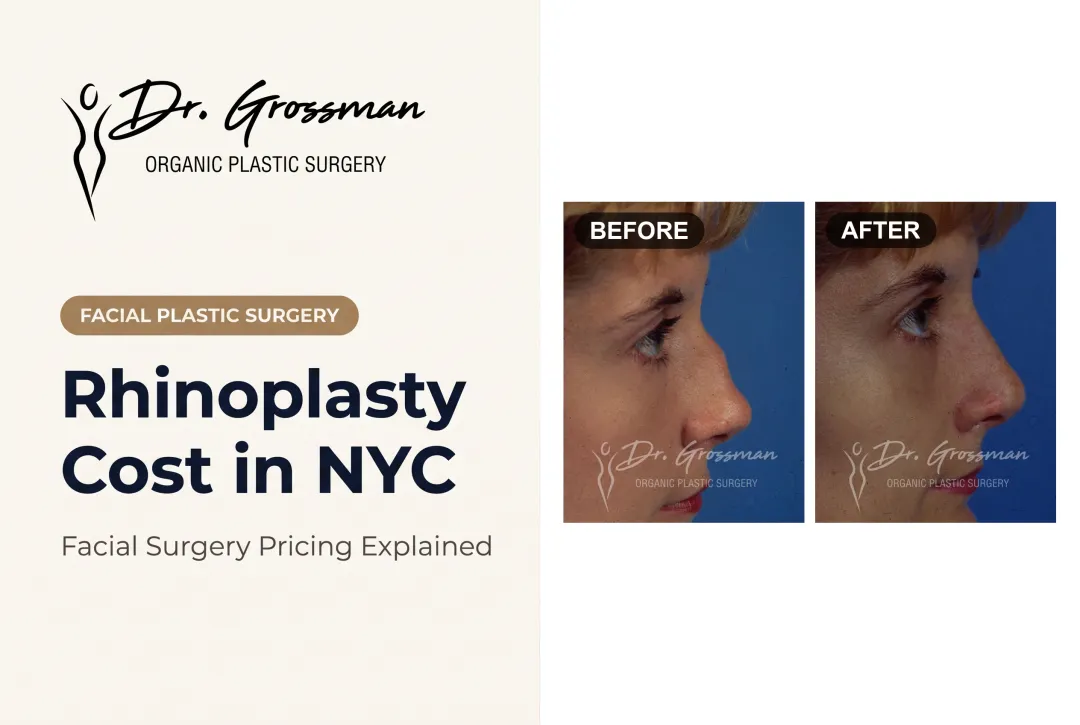
Dr. Leonard Grossman's rhinoplasty page also describes smoothing a bridge bump, lifting or shortening the tip, widening or narrowing the nose, and correcting a downturned or crooked nose. His goal is facial harmony: a nose that suits the rest of your face, not a template. That is also why two "primary rhinoplasties" are rarely the same operation. One patient needs only a dorsal hump smoothed, another needs tip work, and a third needs the septum straightened so they can breathe, and each adds different steps.
A quote may or may not include the surgeon's fee, anesthesia, facility, preoperative evaluation, tests, postoperative visits, garments, and prescriptions. ASPS lists these as possible components, so ask which are bundled. Dr. Grossman's rhinoplasty methods are designed to eliminate the need for compression garments or pillows and to minimize the need for narcotics after surgery, which removes some of those line items and makes recovery more comfortable.
Revision Rhinoplasty
Revision surgery often costs more because the work is harder. Reasons include:
- Scar tissue and disrupted tissue layers
- Altered anatomy and structural weakness
- Limited septal cartilage, sometimes requiring ear or rib grafts
- Longer operative time
A 2022 rib cartilage study notes that harvesting rib cartilage can add operative time and donor-site complications. A verified national 2026 revision fee range is hard to find, so a surgeon's written estimate is the most reliable number. Dr. Grossman's rhinoplasty page notes that surgery can correct deformities from a previous nasal fracture; any earlier surgery is reviewed at your exam.
Functional or Combined Rhinoplasty
Septoplasty, nasal valve repair, turbinate reduction, or trauma repair can be combined with cosmetic work. Dr. Grossman's practice describes septorhinoplasty as correcting medical and cosmetic issues in a single surgery, and his gallery includes nasal reduction for a man with severe rhinophyma, which can interfere with breathing.
Insurance may evaluate eligible functional portions separately. Cosmetic changes and related out-of-pocket costs generally stay with the patient. Coverage is plan-specific, and some plans require prior authorization.
Nonsurgical Rhinoplasty
Liquid rhinoplasty uses filler to alter the nose's contour. Dr. Grossman began reshaping noses with hyaluronic acid filler after Restylane arrived in 1995, coined the term "Nose Job in a Bottle," and was featured with the technique on the TV show Extra in 1996. Its price varies with filler type, amount, and goals.
The catch is durability. Cleveland Clinic says results typically last about six months, so repeat treatment adds up. The FDA also notes nose injection is not an approved dermal filler use, and vessel blockage can cause serious complications. A lower first price is not always a lower long-term cost.
Cost Breakdown of Rhinoplasty
A complete budget goes beyond the advertised surgeon's fee. Break the total into clear line items before you book so nothing is left out.
- Surgeon's fee: Reflects training, experience, case complexity, and time required.
- Anesthesia and facility: Confirm who provides anesthesia, where surgery occurs, facility accreditation, and whether charges are bundled. New York requires accreditation for offices using more than mild sedation. Dr. Grossman's office-based surgery center in Brooklyn is fully accredited by the AAAHC, and because surgery is outpatient, there is no hospital stay to pay for.
- Pre- and postoperative care: Consultations, medical clearance, tests, follow-up visits, splints, and dressings.
- Medications and supplies: Prescriptions and nasal care products, sometimes billed separately.
- Personal costs: Mayo Clinic advises planning about one week off work or school; Dr. Grossman's practice recommends about one to two weeks off work and no strenuous activity or heavy lifting for the first two to three weeks. Budget also for transportation, childcare, and lodging if you travel for surgery.
No reliable national dollar amounts exist for most of these line items, which is why itemization matters.
Key Factors That Affect Rhinoplasty Cost
The final quote reflects medical complexity and the resources needed for safe, individualized care, not just the visual change you want.
Type and Complexity
Primary, revision, open, closed, tip-focused, structural, post-traumatic, and combined procedures need different techniques, operating time, and grafting. Dr. Grossman chooses an open or closed approach at the exam. A closed approach keeps the incisions inside the nose, while an open approach adds a small incision across the skin between the nostrils that typically heals discreetly; either way, the plan is designed to minimize visible scarring. In his gallery, closed rhinoplasty was used for dorsal hump reduction, narrowing and straightening, while an open approach was used to reconstruct a nose injured in a car accident.

Anatomy and goals, not ethnicity or gender alone, should drive the plan and the price.
Surgeon Expertise
Training, surgical focus, and experience with revision or functional cases can influence fees. Look past price:
- Before-and-after results similar to your goals
- Documented plastic surgery residency training and credentials
- Communication and follow-up standards
ASPS says surgeon experience and your comfort with the surgeon matter as much as final cost.
Anatomy and Grafting
Skin thickness, cartilage strength, asymmetry, prior surgery, trauma, and breathing obstruction all matter. Mayo Clinic notes that smaller changes may use cartilage from inside the nose or ear, while larger changes may need rib cartilage. Only an in-person exam can confirm this, and the estimate may change afterward.
Location, Facility, and Anesthesia
Local overhead, operating-room costs, anesthesia arrangements, and demand vary across U.S. markets. Compare a national and a New York figure only when both define their terms the same way. Ask for an itemized local quote rather than relying on a generic citywide uplift. Dr. Grossman's practice standard is local anesthesia with advanced IV sedation instead of general anesthesia, and your anesthesia plan is confirmed at consultation.
Cosmetic Versus Functional Treatment
Elective reshaping is cosmetic. Treatment for a deviated septum, nasal valve collapse, or documented breathing problems may qualify as medically necessary. Verify benefits, preauthorization, deductibles, and coinsurance, and expect functional and cosmetic components to be billed separately.
Recovery and Long-Term Support
Follow-up visits, access to the surgical team, supplies, revision policies, and complication management all affect value. Final tip and bridge refinement can take up to a year, so ongoing support matters.
Low-Cost vs High-Cost Rhinoplasty: What's the Difference?
Price alone does not prove quality or safety. No validated cost-to-quality threshold exists. But quotes can differ in meaningful ways:
- Surgeon experience and case focus
- Surgical setting and accreditation
- Anesthesia provider and arrangements
- Follow-up access and included services
- Likelihood of added charges
An unusually low quote may omit fees, use a different facility, limit follow-up, be promotional, or reflect a simpler plan. Ask:
- What exactly is included: surgeon, anesthesia, facility, tests, visits?
- Where will surgery take place, and is it accredited?
- Who provides anesthesia?
- How are revisions and complications handled?
- Does the quote expire?
Long-term value means weighing safety, natural and functional results, durability, and recovery support. A 2020 systematic review found revision rates ranging from 0% to 10.9% across studies. It does not show that low prices cause revisions, but it is a reminder that a poor first result can mean more complex corrective care.

How to Estimate the Right Budget for Rhinoplasty
Base your budget on your treatment plan and total costs, not the lowest number in a search result.
- Define your outcome. List aesthetic goals, breathing concerns, prior surgery, trauma history, and whether you are considering surgical or nonsurgical treatment.
- Request an itemized written estimate. Ask what is included, what is separate, how revisions and complications are handled, and whether the quote expires.
- Add related expenses. Include consultation, testing, prescriptions, transportation, time off work, supplies, and travel or lodging if needed.
With a full cost picture, quotes are easier to compare. Dr. Leonard Grossman is a Brooklyn, NYC plastic surgeon with more than 30 years of experience who completed a fully accredited plastic surgery residency at Scott & White Memorial Hospital in Texas in 1995. He reviews your medical history, nose, and overall facial structure, tells you whether surgery, filler or both fits, and then gives a personalized quote that itemizes what is included. Surgery is outpatient at his fully accredited Brooklyn center, so you recover at home the same day. Financing options are available. Call 212-585-2133 to schedule at his Brooklyn practice.
What Most People Miss When It Comes to Rhinoplasty Cost
- The surgeon's fee is only part of the bill. Facility, anesthesia, medication, testing, and follow-up can add up.
- More is not better. An unnecessarily extensive procedure for features that do not match your goals adds cost without value. The plan should come from clinical evaluation.
- Cheapest can cost most. Skipping a review of credentials, experience, facility standards, communication, and aftercare risks greater financial and emotional costs later.
Conclusion
Rhinoplasty cost in 2026 depends on procedure type, complexity, location, surgeon, facility, anesthesia, insurance eligibility, and what the quote includes. National benchmarks cover surgeon fees alone, so they can't stand in for a personal quote.
A useful estimate is itemized and transparent. The best value balances safety, expertise, functional results, durability, follow-up care, and your personal goals.
Frequently Asked Questions
Would insurance pay for a nose job?
Purely cosmetic rhinoplasty is generally not covered. Medically necessary functional work, such as septoplasty, may qualify for partial coverage depending on your plan, documentation, and preauthorization.
Is a nose job painful?
Anesthesia prevents pain during surgery. Mayo Clinic reports most people rate pain 0-4 out of 10 the day after. Swelling, pressure, and tenderness are managed per your surgeon's instructions. Dr. Grossman's techniques minimize the need for narcotics: most patients manage with over-the-counter medication, and prescription pain medication may be issued.
How risky is it to get a nose job?
Risks include bleeding, infection, anesthesia reaction, breathing problems, numbness, asymmetry, scarring, and possible further surgery. Discuss your individual risks and revision possibilities at consultation.
Which age is best for nose surgery?
There is no universal age. Timing depends on physical development, health, emotional readiness, realistic expectations, and the reason for surgery. Dr. Grossman advises younger patients to wait until after puberty, when facial growth is complete.
What happens 10 years after rhinoplasty?
Results are intended to be long-lasting, but aging, weight changes, trauma, and skin changes can alter the nose. Regular follow-ups are recommended even years later.