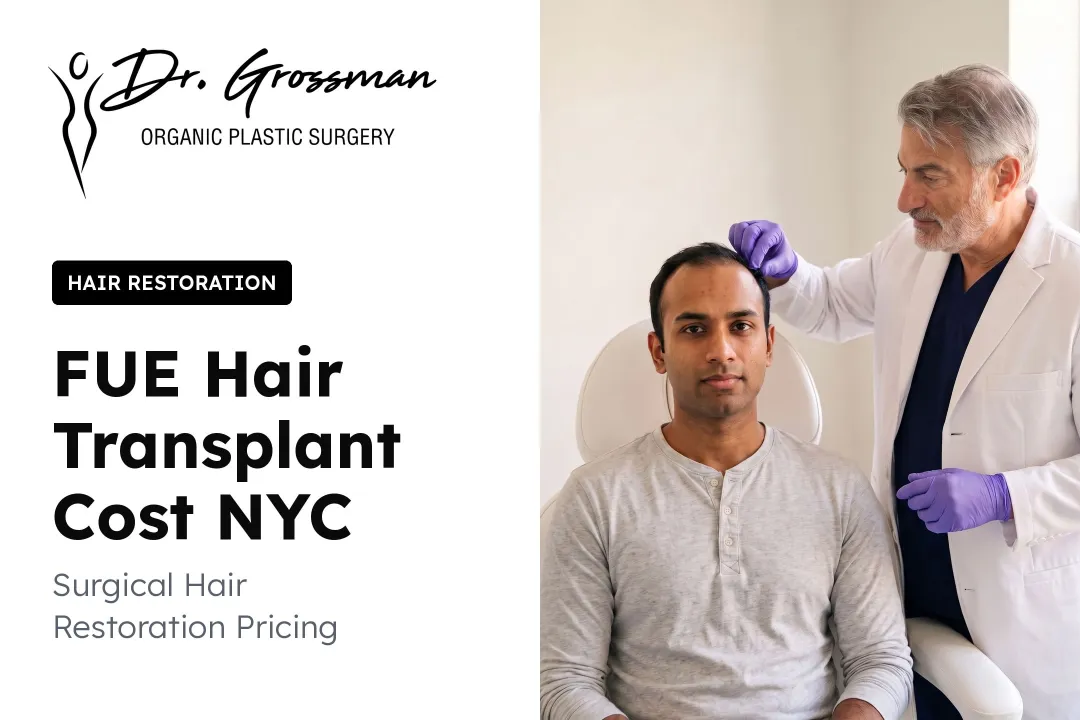

Published figures can also mislead. Even major medical societies, including The Aesthetic Society, list cost factors without publishing dollar amounts. Cost also varies significantly by geographic location and by your own scalp, hair and donor supply, so this guide doesn't invent a price table. Instead, it shows how quotes are built, what to compare, and what to ask before you commit. It also explains how Dr. Leonard Grossman performs FUE with the NeoGraft system at his Brooklyn, NYC practice.
Key Takeaways
- No verified national FUE price list exists, and cost varies significantly by location and by the individual patient, so treat any online figure with caution.
- Graft count, donor supply, surgeon involvement, location, and complexity drive the total.
- A low quote may leave out physician involvement, aftercare, medication, or follow-up.
- Value means safety, natural results, transparency, and donor preservation, not just the lowest fee.
- Dr. Grossman's NeoGraft FUE is performed under local anesthesia, leaves no linear scar, needs no stitches or staples, and most patients resume daily activities the next day.
How Much Does an FUE Hair Transplant Cost? (Pricing Overview)
FUE has no single standard price across the United States. Any published range is a planning estimate until a physician examines your scalp, measures your donor area, and discusses your goals.
Misreading a quote has real consequences:
- You may underestimate how many grafts you need.
- You may compare quotes that cover different services.
- You may overlook recovery-related costs.
- You may hire a provider without learning who performs the surgical steps.
What Shapes FUE Transplant Cost: Session Size
Public sources don't publish current U.S. dollar bands for FUE by session size. WebMD's general hair transplant overview covers all transplant types, so it isn't a reliable FUE benchmark. Sessions generally scale as follows:
- Smaller sessions: limited hairline or temple work, fewer grafts, shorter operating time.
- Standard sessions: the most common case size. The 2025 ISHRS Practice Census found the average FUE case involved 2,262 grafts, and 56% of typical cases fell between 1,000 and 1,999 grafts.
- Extensive sessions: larger areas, multiple sessions, repair work, or complex hair loss, all of which demand more time and skill.
The census reflects ISHRS member practices worldwide, not U.S. pricing. Use it to understand case size, not cost.
Per-Graft Pricing and Graft-Count Examples
A graft is a follicular unit, a natural group of one to three (rarely four) hairs. ISHRS puts the average at about 2.4 hairs per unit. A quote for 2,000 grafts therefore means roughly 4,800 individual hairs, though your own ratio will differ.
Clinics price by the graft or by the session. To build your own estimate, ask each clinic for its rate and multiply:
- Get the per-graft rate or session fee in writing.
- Ask for the recommended graft count for your hair loss pattern.
- Multiply, then add any separate fees.

Run that math at 1,000, 2,000, and 3,000 grafts to see how the total scales. These are illustrations of method, not quotes.
On "10,000 hair grafts": patients often mean 10,000 individual hairs, not 10,000 follicular units. Those are very different amounts of surgery. Confirm the terminology, graft count, and hairs per graft with the clinic.
What the Price May Include
Break any quote into categories:
- One-time: consultation, scalp assessment, any medically indicated testing
- Procedure: surgeon and team fees, extraction, recipient-site creation, implantation, facility, anesthesia
- Recovery: prescriptions, wound-care supplies, washing products, follow-up visits, travel, time off work
- Optional or future: adjunct treatments and revision procedures, which you should never assume are included
Cosmetic hair transplants are usually paid out of pocket. The Aesthetic Society and Cleveland Clinic both note insurance rarely covers elective cosmetic procedures. Reconstructive cases, such as scarring or injury, may differ, so confirm with your insurer and provider.
Key Factors That Affect the Cost of an FUE Hair Transplant
The final price reflects clinical workload, surgical expertise, facility standards, and your long-term plan. The number on a price list captures only part of that.
Graft Count and Treatment Area
A hairline needs different work than a crown or diffuse thinning. Larger areas mean more grafts and longer sessions. Two people booking "an FUE transplant" can therefore have very different procedures: different graft counts, different extraction patterns, and sometimes staged sessions.
ISHRS guidelines say planning should weigh donor and recipient density, hair caliber, curl, color, and scalp condition. Coarse hair that contrasts with the scalp covers more area per graft than fine, light hair, so the recommended count shifts.
Surgeon Expertise and Division of Responsibilities
Training, restoration experience, and aesthetic judgment affect price. So does how much of the surgery the physician personally performs. ISHRS's position statement treats incisions for graft harvesting and recipient-site creation as surgery that a trained, licensed physician should perform, with supervised extenders only where the law permits.
Ask who will:
- Examine you and design the hairline
- Extract the grafts
- Create the recipient sites
- Implant the follicles
- Supervise any technicians
At Dr. Grossman's practice, he evaluates your hair loss pattern, scalp condition, and overall health himself at the pre-operative consultation.
Location, Facility, and Clinical Team
Regional operating costs, staffing, privacy, emergency readiness, and follow-up access all affect price. A major city doesn't guarantee better work, and a smaller market doesn't mean lower quality. Compare the facility and care team, not just the address, and ask whether the facility is accredited.
Technology, Anesthesia, and Procedure Configuration
Manual, motorized, and robotic FUE all exist. More technology isn't automatically better. Dr. Grossman uses the NeoGraft system, which lifts individual follicles with pneumatic controls while maintaining the natural grouping of hairs, then places them without stitches or staples. Because follicles come out one by one rather than in a strip, there is no linear donor scar, which keeps scarring minimal and lets you wear your hair short.
A 2024 split-donor study of 13 men found ARTAS and traditional FUE had similar yield (82.05% vs. 90.03%, not statistically significant), though discard rates were higher with ARTAS. It's a small trial, so don't treat it as proof either way. A consistent price premium for any method is hard to pin down from published data.

If a written quote lists anesthesia, longer sessions, staged procedures, or specialized equipment, ask what each adds.
Complexity, Donor Supply, and Long-Term Planning
Repair cases, scar tissue, advanced loss, limited donors, and unusual hair characteristics demand more expertise. A good plan also anticipates future loss. ISHRS guidance warns that oversized FUE sessions can extend beyond the safe donor zone, risking visible scars or thinning. Maximizing grafts in one sitting can cost you later.
Low-Cost vs High-Cost FUE: What's the Difference?
Price alone does not tell you whether care is safe or high quality. Judge each quote by what the fee includes and how openly the practice delivers care.
Performance and Naturalness
For a lower quote, check whether it includes individualized hairline design, density planning, and before-and-after photos of cases like yours. For a higher quote, a premium may reflect more physician planning, experienced staff, or complex-case management. Ask for evidence rather than assuming.
Safety and Quality Controls
Either way, ask about:
- Facility standards and sterilization
- Graft handling
- Physician oversight during surgery
- Postoperative support
- Credentials and licensure of everyone who makes incisions
A 2024 scoping review found overall hair transplant complication rates of 1.2% and 4.7% in two large series. That review combines FUE and FUT, so it isn't an FUE-specific risk figure.
Precision, Donor Preservation, and Durability
Poor graft placement, over-harvesting, or an unrealistic hairline can be hard to fix. A higher fee may be worth it if it buys careful donor management and a plan built for the long run. Verify that claim rather than trusting the price tag.
Maintenance and Total Cost of Ownership
Compare the procedure fee with medications, follow-ups, optional therapies, travel, time off, and possible revision. Transplanted follicles keep growing, but surrounding native hair can keep thinning. The American Academy of Dermatology notes a dermatologist may recommend medicine to slow further loss, which is an ongoing cost.
Quote Red Flags
- Unclear graft counts or vague inclusions
- Pressure to book immediately
- No chance to meet the physician
- No clarity on who performs each surgical step
- No plan for postoperative concerns
Ask for an itemized quote, written aftercare instructions, refund and cancellation terms, and the name of whoever provides follow-up.
How to Estimate the Right Budget for an FUE Hair Transplant
Your best budget comes from your treatment plan and total expected costs, not a generic online average.
Build a Complete Cost Estimate
Add up:
- Graft count or session fee
- Consultation and testing
- Facility and anesthesia fees
- Medication, aftercare, and follow-up
- Transportation and accommodation
- Time away from work
- Financing charges
- Optional treatments
The AAD says surgery takes about 4 to 8 hours, and Cleveland Clinic says most people feel well within a day or two. Dr. Grossman's practice notes most NeoGraft patients return to normal daily activities the next day. A practice article on FUE adds that you can usually style and comb your hair after about 10 days, and new growth can take 10 months to a year to reach the length you want. Plan time off accordingly.

Compare Quotes on a Like-for-Like Basis
Put these side by side for every clinic:
- Named surgeon
- How grafts are counted
- Procedure method
- Who performs each step
- Inclusions and follow-up schedule
- Possible extra fees
- Quote expiration date
- Whether revision is addressed
What Most People Miss
Patients often fixate on the upfront figure and overlook:
- Graft-versus-hair terminology
- Continuing native hair loss
- Recovery time and donor limits
- Cost of corrective surgery
If you're considering FUE in New York, Dr. Leonard Grossman offers NeoGraft hair restoration, which uses the FUE method. Good candidates are men and women with mild to moderate hair loss, sufficient donor hair, and loss that has stabilized. Recovery needs no compression garments, narcotics or special pillows, and without a linear scar you can wear your hair short or long. The aim is natural hair growth in natural groupings, without a "doll's hair" look, as a practice article puts it. His quote reflects the extent of your hair loss, the number of grafts required, and your goals, and financing options are available (Cherry, Prosper). Treatment takes place at his fully accredited (AAAHC) surgery center at 3039 Emmons Avenue in Brooklyn; call 212-585-2133 to schedule an evaluation.
Conclusion
FUE cost varies widely with graft needs, surgeon involvement, facility, technology, complexity, and included services. A transparent, itemized quote from a qualified physician, in an accredited setting, tells you more than any headline price.
Book an individualized consultation, get every cost in writing, and choose a plan that balances safety, natural-looking results, donor preservation, and long-term value.
Frequently Asked Questions
How much do 1,000 FUE grafts cost?
It depends on where you are treated, the clinic's per-graft or session pricing, what's included, and your clinical needs, since prices vary significantly by location and by patient. Ask for a written rate and a line-item quote instead of relying on a fixed figure.
How much do 2,000 FUE grafts cost?
The estimate varies by surgeon, location, facility, technique, and inclusions. A consultation is needed to confirm 2,000 grafts is right for you.
How much do 3,000 FUE grafts cost?
Larger sessions affect per-graft pricing, procedure time, staffing, anesthesia, and aftercare. No guaranteed price applies, so request a personalized written quote.
How much do 10,000 hair grafts cost?
"10,000 hair grafts" often confuses individual hairs with follicular grafts. Confirm the graft count, hairs per graft, and total session needs with your provider.
How painful is a FUE hair transplant?
Local anesthesia is common, and some patients also take a mild sedative. You may feel pressure during surgery, with tenderness or swelling afterward. Dr. Grossman performs NeoGraft under local anesthesia, his patients typically need no narcotics afterward, and recovery calls for no compression garments or special pillows.
How long do hairline transplants last?
Transplanted follicles are meant to keep growing, while surrounding native hair may continue to thin. Dr. Grossman's practice considers NeoGraft results permanent because the transplanted follicles resist the factors that cause hair loss. Results depend on candidacy, technique, hair-loss progression, and follow-up care.