Skip to content

What if the secret to naturally full, pillowy lips wasn’t found in a synthetic syringe, but within your own body’s living tissue? Many people today are experiencing “filler fatigue,” feeling exhausted by the need for repeat injections every few months and the lingering anxiety of placing foreign substances in their bodies. If you’ve considered fat grafting to lips, you’re likely looking for a way to avoid the dreaded “duck lip” look or the stiff, artificial feel that sometimes comes with traditional synthetic materials.
It’s understandable to want a solution that respects your body’s natural harmony while providing lasting results. This procedure offers a beautiful, permanent alternative by using your own autologous fat to restore volume and improve the delicate skin texture around the mouth. This integrative approach doesn’t just “fill” a space; it rejuvenates the area with living cells that move and feel exactly like you. In this guide, we’ll walk through how the process works, the unique benefits of using your own biological material, and what you can expect as you move toward a more vibrant, natural smile.
Key Takeaways
- Understand how Adipose-Derived Stem Cells (ADSCs) within your own tissue go beyond simple volume to actively nourish and rejuvenate the skin around your mouth.
- Discover why fat grafting to lips provides a permanent, biocompatible solution that resolves the anxiety of foreign substances while ending the cycle of “filler fatigue.”
- Learn the methodical two-step process of harvesting and purifying your own living cells to ensure a soft, natural feel that harmonizes with your unique facial anatomy.
- Explore an integrative approach to lip enhancement that supports your body’s natural healing intelligence for results that feel authentic to you.
What is Fat Grafting to the Lips?
Fat grafting to lips is the art of using your body’s own resources to restore what time or genetics have diminished. Unlike synthetic materials that simply occupy space, this process involves autologous fat grafting, which is the gentle relocation of your own living adipose cells from one area of the body to another. It’s a deeply restorative technique that aligns with the body’s natural healing intelligence. By choosing a fat transfer procedure, you’re not just adding bulk; you’re transplanting living tissue that continues to thrive in its new home.
The core of this procedure’s success lies in bio-compatibility. When we introduce foreign substances, the body often reacts with a localized inflammatory response as it attempts to identify the intruder. With your own cells, there’s a biological “handshake” of recognition. The body accepts the tissue as its own, which significantly reduces the risk of allergic reactions or the formation of hard granules. This creates a result that isn’t just soft to the eye, but feels authentic and pillowy to the touch.
There is also a distinctive dual benefit to this integrative approach. The process begins with a specialized form of liposuction to harvest a small amount of fat from a donor site, such as the abdomen, hips, or thighs. This allows for subtle body contouring in an area of concern while simultaneously providing the high-quality tissue needed to rejuvenate the lips. It’s a harmonious way to balance the body’s proportions while achieving long-term facial vitality.
The Evolution of Lip Augmentation
The journey toward the perfect smile has changed significantly over the decades. In the 1980s and 90s, early collagen injections were the standard, though they often required frequent upkeep. Later, hyaluronic acid dermal fillers became the dominant choice for their ease of use. However, as we move through 2026, there’s a clear shift toward autologous solutions. Patients are increasingly moving away from the “overfilled” look in favor of a natural aesthetic that respects their unique facial harmony. They’re seeking solutions that are “self-derived” and permanent, rather than temporary and external.
Who is the Ideal Candidate for Lip Fat Transfer?
This procedure is a wonderful option for those who feel their lips have lost volume due to the natural aging process. It’s particularly effective for:
- Individuals with fine vertical “smoker’s lines” who want to improve skin texture.
- Patients experiencing “filler fatigue” who are tired of the six-month injection cycle.
- Those who prefer a holistic, foreign-substance-free approach to their self-care.
- Anyone with a small amount of harvestable fat who desires a permanent increase in lip fullness.
The Biology of Fat: Why It Is Superior to Synthetic Fillers
To truly appreciate the power of fat grafting to lips, we must first change how we view fat itself. In popular culture, fat is often dismissed as unwanted “grease” or simple storage. In the clinical world of integrative medicine, we recognize adipose tissue as a complex, living organ. It’s a dynamic endocrine system that communicates with your body, releasing hormones and growth factors that support overall tissue health. When we choose fat over synthetic gels, we aren’t just filling a space; we’re transplanting a biological matrix that’s designed to thrive.
Synthetic fillers are essentially inert materials. They sit between your tissues, providing volume through physical displacement. While effective for temporary changes, they don’t interact with your biology in a meaningful way. Fat, on the other hand, is alive. It contains a rich environment of nutrients and signaling molecules that work to nourish the surrounding area from the inside out. This fundamental difference is why fat feels so much more authentic to the touch. It moves when you smile and yields when you press, mirroring the natural mechanics of your own body.
The “Living Tissue” Advantage
Once fat cells are delicately placed in their new home, they begin a remarkable process called neovascularization. This is the body’s way of extending new blood vessels to reach and feed the transplanted cells. This integration ensures the tissue’s survival and longevity. Unlike traditional injectables that eventually dissolve, these living cells become a permanent part of your lip structure. You can explore more about the scientific nuances of the Facial Fat Grafting Procedure to understand how this survival rate is optimized through modern surgical techniques.
Regenerative Properties and Stem Cells
The most exciting aspect of fat grafting to lips is the presence of Adipose-Derived Stem Cells (ADSCs). These cells possess a unique “healing intelligence” that synthetic materials simply cannot replicate. These stem cells actively work to repair the delicate skin around the mouth, often softening perioral wrinkles or “straw lines” that have formed over years. This regenerative action improves the actual quality and color of your lips, replacing a dull or thinning appearance with a healthy, vibrant glow. This effect is largely due to the increased blood flow and collagen support that only living tissue can provide.
This holistic approach to beauty prioritizes long-term vitality over the quick, repetitive cycles of traditional aesthetics. By supporting your body’s natural systems, you create a look that is both sustainable and deeply personal. If you’re ready to move beyond temporary fixes, learning more about integrative facial rejuvenation can help you align your aesthetic goals with your overall wellness philosophy.
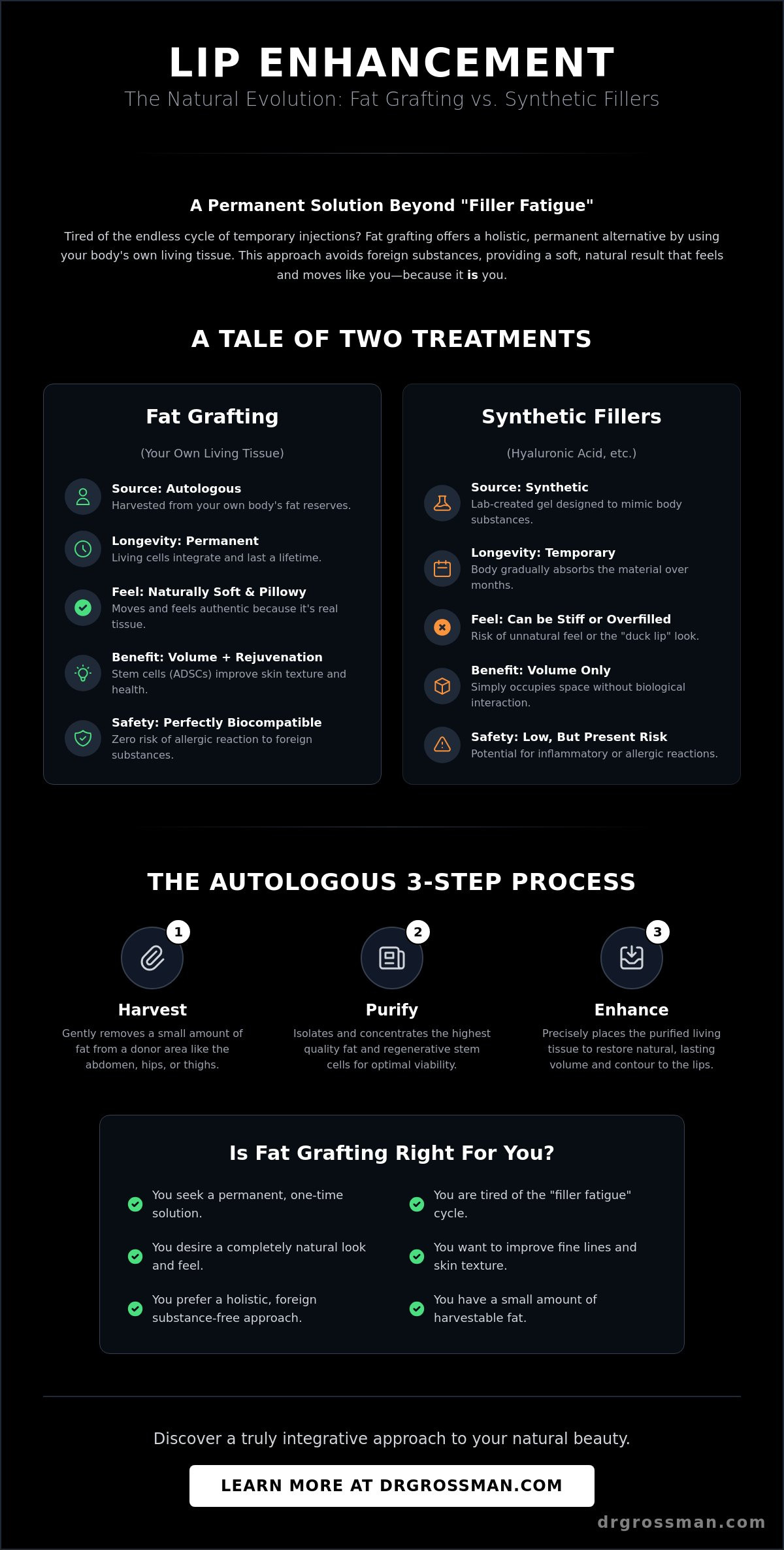
Fat Grafting vs. Dermal Fillers: A Comparative Analysis
The long-term investment value of a one-time procedure is often what surprises patients the most. When you look at the cumulative cost and time spent on maintenance for fillers over a decade, the shift toward a surgical solution becomes a logical choice for whole-body wellness. It’s about moving away from a “quick fix” mentality and toward a path of lasting rejuvenation that respects your body’s natural aging process and biological integrity. For patients in the greater metropolitan area, exploring facial fat transfer NYC options can provide a clearer picture of how this integrative approach compares to the ongoing costs and commitments of synthetic alternatives.
Longevity and the “Permanent” Myth
It’s vital to have a realistic understanding of how your body interacts with transplanted tissue. During the initial months following fat grafting to lips, the body will naturally absorb a portion of the transferred fat as it establishes a new blood supply. However, the cells that remain after this initial healing phase are permanent residents. They don’t dissolve or wash away like hyaluronic acid. While some patients might choose a second “touch-up” session to reach their desired level of pillowy fullness, the results are fundamentally stable for a lifetime, unlike the endless maintenance required by synthetic alternatives.
Texture, Movement, and Feel
One of the most profound benefits of living tissue is how it behaves when you speak, laugh, or kiss. Synthetic fillers, even the most advanced versions, can sometimes feel like a distinct “shelf” or a slightly firm mass within the lip. Properly processed fat integrates so seamlessly that there’s no “lump” or artificial resistance. Because these cells are your own, they respond to the same biological signals as the rest of your face. Natural movement is the hallmark of successful grafting. This ensures that your smile remains expressive and authentic, never appearing frozen or distorted by the weight of foreign materials.
The Procedure: From Harvesting to Healing
The journey toward permanent lip restoration is a methodical, three-step process that respects the living nature of your cells. It begins with gentle micro-liposuction, usually from the abdomen or inner thigh. A specialized, very thin cannula is used to harvest the fat, ensuring the donor site remains smooth while collecting the most robust adipose tissue. This isn’t the aggressive liposuction used for major body contouring; it’s a delicate extraction designed to preserve the integrity of the cell membranes.
Once harvested, the tissue undergoes a vital purification process. This is where clinical precision truly matters for the success of fat grafting to lips. We use centrifugation or specialized filtration to separate the healthy, living fat cells from unwanted fluids, oils, and metabolic waste. This step ensures that only the most viable, nutrient-rich cells are prepared for transfer. Finally, these purified cells are meticulously placed into the lip muscles and borders using a multi-layered, micro-droplet technique. By dispersing the fat in tiny amounts, we ensure each cell is close to a blood vessel, which significantly improves the “take rate” or survival of the graft.
It’s natural to feel a bit surprised by your appearance immediately after the procedure. We intentionally perform a slight “over-correction.” Because we expect the body to naturally absorb a small percentage of the transferred volume during the first few weeks, we inject slightly more than the final desired result. Your lips will look very full, perhaps even exaggerated, for the first 72 hours as the initial swelling peaks.
What to Expect During Recovery
The healing process follows a predictable, rhythmic flow. During days one through three, you’ll manage the most significant swelling; cold compresses and keeping your head elevated can help support the body’s natural drainage. By the end of the first week, the “overfilled” look begins to fade, and the tissue starts to soften. Between week two and month three, the surviving fat cells establish a permanent blood supply. This is the settling phase, where the final, soft, and natural shape of your lips truly emerges. For a detailed breakdown of each stage of healing, our day by day fat transfer to face recovery time guide provides an integrative roadmap to help you navigate every milestone with confidence.
Integrative Aftercare for Optimal Graft Survival
Supporting your body’s natural healing intelligence is essential for the best results. We recommend a focus on deep hydration and nutrient-dense foods to nourish the new cell grafts from the inside out. In the first week, “quieting” the lips is vital. This means avoiding the use of straws, limiting excessive talking, and skipping intense exercise. The mechanical puckering motion of a straw can actually displace the delicate new cells before they’ve had a chance to anchor. To learn more about how we support your recovery, explore our integrative facial rejuvenation options to see how we prioritize your long-term wellness.
Choosing an Integrative Approach for Your Lips
Choosing an integrative approach means viewing your aesthetic goals through the lens of whole-body health. The success of fat grafting to lips isn’t solely determined by the procedure itself, but by how well we support your body’s natural healing intelligence. This begins with the technical skill of the surgeon. The “take rate,” or the percentage of fat that permanently integrates, is highly dependent on the gentleness of the harvest and the precision of the placement. By treating each living cell with care, we optimize the environment for these cells to thrive and become a lasting part of your smile.
A holistic consultation is the cornerstone of this process. We don’t simply look at your lips in isolation; we examine your entire facial harmony. The goal is to move beyond the outdated concept of “bigger” lips and toward a result that is “better” and more “youthful.” This involves restoring the subtle contours that time may have softened, ensuring your lips complement your eyes, cheeks, and jawline for a balanced, vibrant appearance. It’s about enhancing your unique features rather than masking them with artificial volume.
Customizing Your Results
Every face tells a unique story, and your rejuvenation plan should reflect that. We tailor the volume to match your specific facial proportions, ensuring that the Cupid’s bow and lip borders remain crisp and defined rather than blurred or over-inflated. For many patients, combining this procedure with a broader facial fat transfer provides the most comprehensive result, as it addresses volume loss across the entire face simultaneously. This ensures that your rejuvenated lips look perfectly at home within a refreshed, healthy facial structure.
The Next Step in Your Rejuvenation Journey
Preparing your body for success is just as vital as the surgery itself. A foundation of good nutrition, proper hydration, and a calm nervous system creates the ideal environment for your new cells to flourish. Understanding that fat transfer surgery is a cornerstone of modern, health-forward aesthetics allows you to feel empowered in your choice. It’s a move away from temporary fixes and toward a lifestyle of sustainable vitality. If you’re ready to explore how this natural, permanent solution can restore your confidence, we invite you to schedule a consultation to see if you’re a candidate for this integrative path toward lasting beauty.
A Path Toward Lasting Vitality and Natural Beauty
Your journey toward lasting beauty doesn’t have to rely on a cycle of synthetic injections. By choosing fat grafting to lips, you’re opting for a biological restoration that respects your body’s natural architecture. This procedure provides more than just volume; it introduces living cells and regenerative stem cells that improve the very health and texture of your smile for a lifetime.
With over 25 years of expertise in advanced fat grafting, Dr. Grossman utilizes pioneering techniques that prioritize your whole-body wellness. This integrative approach ensures your results feel soft, move naturally, and harmonize with your unique facial features. It’s about empowering you to feel vibrant and authentic in your own skin without the anxiety of foreign materials.
If you’re ready to move toward a more permanent and holistic form of self-care, we’re here to guide you through every step of the process. Schedule your integrative consultation with Dr. Grossman today to discover how your own living tissue can restore your youthful vitality. Your most natural smile is waiting to be rediscovered.
Frequently Asked Questions
Is fat grafting to the lips truly permanent?
Yes, the fat cells that survive the initial integration phase become a permanent part of your anatomy. Unlike hyaluronic acid fillers that the body eventually metabolizes, these living cells remain for a lifetime. You won’t need the repetitive touch-ups every six months that characterize traditional filler treatments, making it a sustainable choice for long-term lip rejuvenation.
How much fat will actually survive after the procedure?
Typically, about 50% to 70% of the transferred fat survives permanently once it establishes a new blood supply. This is why we perform a slight over-correction during the initial procedure. Once the body nourishes these cells through neovascularization within the first few months, the remaining volume is stable and behaves just like the rest of your natural tissue.
Does lip fat grafting hurt more than fillers?
The procedure is performed under local anesthesia or sedation, so you won’t feel pain during the process. While the recovery involves more initial swelling than a standard filler injection, most patients describe the sensation as a feeling of tightness or mild soreness. We focus on gentle micro-harvesting techniques to minimize discomfort at the donor site as well.
Will my lips feel lumpy or hard after fat transfer?
No, properly processed and purified fat feels soft and entirely natural to the touch. Because we use a micro-droplet technique to layer the fat, it integrates seamlessly into the lip muscle. This avoids the “shelf” effect or firmness sometimes felt with synthetic materials, ensuring your lips move naturally during speech and expressions.
Where does the donor fat usually come from?
Donor fat is typically harvested from areas with stable adipose tissue, such as the abdomen, outer thighs, or hips. We only need a very small amount for fat grafting to lips. This allows us to choose a site that might also benefit from subtle contouring, supporting your overall body harmony while providing the living cells needed for your restoration.
Can I get fat grafting if I already have fillers in my lips?
Yes, but it’s essential that any existing synthetic fillers are fully dissolved or metabolized first. We want to ensure the fat is placed into your natural tissue rather than on top of a temporary gel. This creates a clean slate for the living cells to establish a healthy blood supply and ensures the most predictable, permanent results.
How long is the downtime for lip fat grafting?
You should plan for about 7 to 10 days of social downtime. While you can return to light activities within a day or two, the initial swelling is quite pronounced for the first 72 hours. By the end of the first week, most of the significant swelling and any minor bruising have usually subsided enough to return to your normal routine.
What happens if I lose or gain weight after the procedure?
The transplanted fat cells will behave exactly like the fat cells in the rest of your body. If you gain significant weight, those cells may expand; if you lose a large amount of weight, they may shrink. However, because we use such a small volume for the lips, these changes are usually very subtle and don’t typically distort the overall aesthetic result.