Skip to content


A natural-looking result depends on balance, not simply bringing the ears closer to the head. The pros and cons of otoplasty for adults include the possibility of changing prominent ears and improving symmetry, alongside risks such as infection, scarring, altered sensation, or ears that remain uneven. Otoplasty reshapes the outer ear; it doesn’t change hearing.
It’s understandable to want a clear picture of what happens before surgery, especially when weighing a lasting change to your appearance. This guide explains what a consultation and preparation may involve, who may be a suitable candidate, how careful planning can help reduce risks, and what recovery and results may look like. It also explains why some asymmetry may remain and why the goal is a balanced, natural appearance rather than perfectly identical ears.
Key Takeaways
- Plan for recovery as well as surgery: activity limits and protecting the ears can support healing.
- Consider candidacy in light of your health, healing factors, and the specific risks of ear reshaping.
- Discuss your desired ear position and the possibility of asymmetry or revision before deciding on surgery.
- Learn how an experienced otoplasty surgeon can help shape a natural-looking result around your features.
How safe is otoplasty for adults in real terms?
Adult ear surgery generally focuses on reshaping prominent ears, but it still involves surgical risks and recovery. Safety depends on your health, the procedure, and careful aftercare. Possible complications include bleeding or blood collecting under the skin, infection, delayed healing, wound separation, and visible or thick scars. Numbness or altered skin sensation can also occur, and pain may last longer than expected.
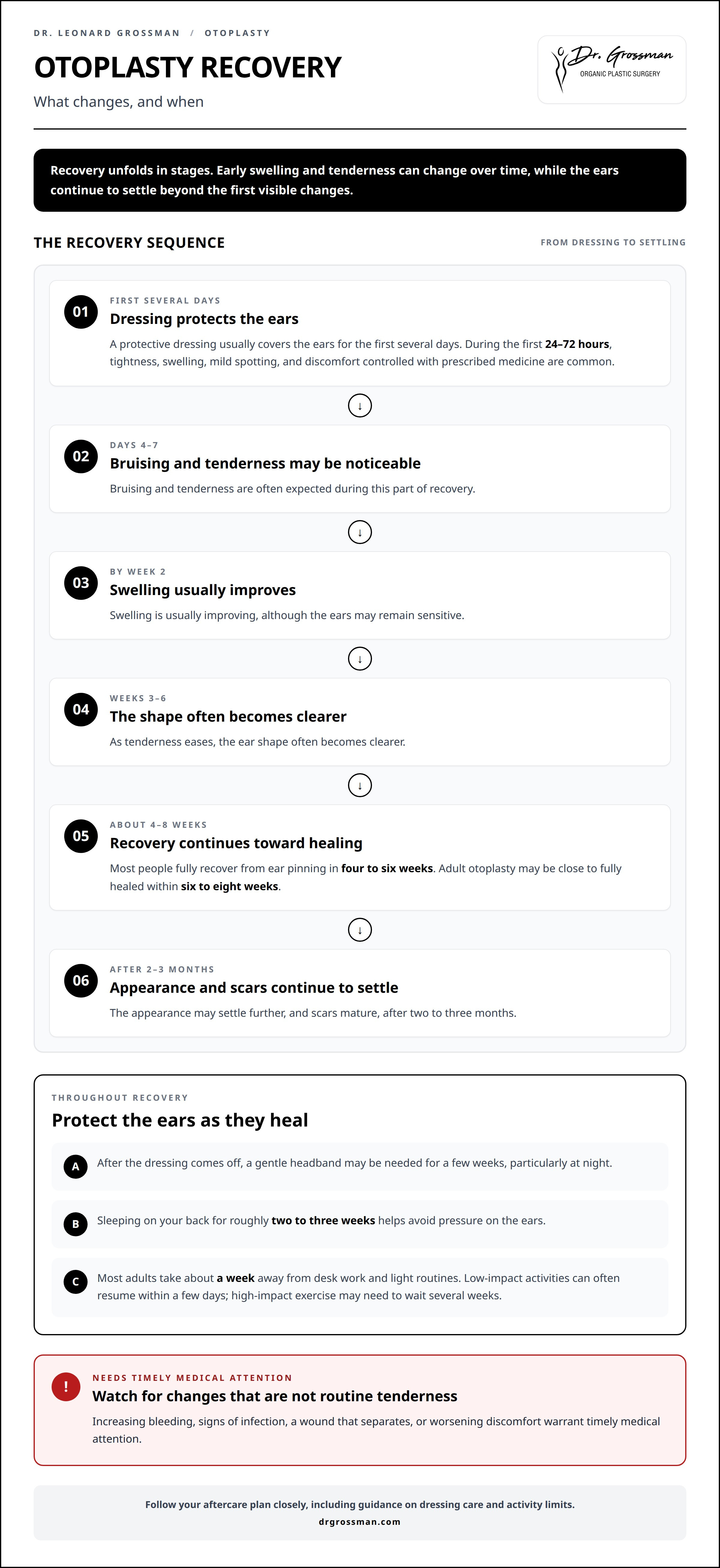
After surgery, a protective dressing usually covers the ears for the first several days. Tightness, swelling, mild spotting, and discomfort controlled with prescribed medicine are common during the first 24-72 hours. Bruising and tenderness are often expected on days 4-7. By week 2, swelling is usually improving, although the ears may remain sensitive. During weeks 3-6, the shape often becomes clearer as tenderness eases.
After the dressing comes off, you may need to wear a gentle headband for a few weeks, particularly at night. Sleeping on your back for roughly two to three weeks helps avoid pressure on the ears. Most adults take about a week away from desk work and light routines. Low-impact activities can often resume within a few days, while high-impact exercise may need to wait several weeks.
Healing continues beyond the first visible changes. Most people fully recover from ear pinning in four to six weeks, while adult otoplasty may be close to fully healed within six to eight weeks. The appearance may settle further, and scars mature, after two to three months. Follow your aftercare plan closely, including guidance on dressing care and activity limits.
Know which changes need prompt attention. Increasing bleeding, signs of infection, a wound that separates, or worsening discomfort warrant timely medical attention. These may signal complications rather than routine tenderness. A plastic surgeon can explain how your health and healing affect risk, and what follow-up supports recovery. General statements about plastic surgery organizations don’t establish a specific safety standard, so rely on clear, procedure-specific guidance.
Risks and candidacy considerations
The pros and cons of otoplasty for adults depend partly on ear anatomy, health, and healing factors. A candidacy assessment connects the change you want with the procedure’s possible complications. It also helps clarify whether your goal is a realistic adjustment in ear position or a degree of symmetry surgery cannot ensure.
Surgical Risks and Complications
Possible complications include bleeding, a blood collection beneath the skin, infection, delayed healing, or wound separation. Scars can become visible, thick, or lumpy. These risks matter because they may affect comfort and the ear’s contour after recovery, not just its early appearance.
Cartilage can develop sharp folds or uneven contours. Overcorrection may leave ears too close to the head, while undercorrection may leave them more prominent than you hoped. Swelling can also make the early shape difficult to assess. Discussing the intended position and degree of correction helps establish a shared goal.
Candidacy Considerations
Healthy adults in their 30s, 40s, 50s, and older can do well with otoplasty, and there’s no upper age limit. Age alone doesn’t determine whether surgery is appropriate. A medical assessment considers ear structure, general health, healing factors, and the patient’s expectations.
Some adults with microtia or health conditions that affect healing may need an alternative approach. This distinction matters because prominent ears and other structural concerns may require different planning. Otoplasty is cosmetic, so its intended benefit is a change in appearance, not improved hearing.
Relapse and Revision Surgery
Cartilage may partly relapse after surgery, allowing an ear to move outward again. This can lessen the correction or change the balance between ears. A small number of patients may need a minor touch-up, so the possibility of further treatment belongs in your decision alongside the hoped-for result.
Revision surgery may be considered if relapse, asymmetry, or an unsatisfactory contour persists. The concern matters: an ear projecting more than desired differs from one positioned too close to the head. The pros and cons of otoplasty for adults should include how a revision might address the specific concern. Discuss your goals and concerns to help clarify whether surgery fits your priorities.
How can you reduce the risks before choosing a clinic or surgeon?
Risk reduction starts with a clear surgical plan, realistic goals, and an honest review of your health. Otoplasty techniques and outcomes vary. Surgeons may reshape cartilage with customized sutures, while a stitch method can adjust ear position without removing skin. The approach depends on your ear structure and planned correction, not on one technique being right for everyone.
Choosing a Surgeon and Clinic
Choose a plastic surgeon who has performed many otoplasties and can explain the planned correction in terms you understand. This matters because technique, cartilage shape, and the intended position all influence the result. Ask how the clinic handles follow-up and what steps are planned if healing or symmetry becomes a concern.
During the discussion, describe what bothers you about your prominent ears and what change would feel balanced. Review the expected result and the possibility of relapse or revision. A useful conversation covers both the intended improvement and the limits of surgery, rather than treating a specific ear position as a universal ideal.
Consultation and Surgery Preparation
A consultation connects your goals with your medical history, ear anatomy, and surgical options. Bring a complete list of prescription medicines, over-the-counter drugs, and supplements. Some medicines may affect surgical planning, so don’t stop or change them without instructions from your surgical team.
Before surgery, clarify the procedure, anesthesia plan, recovery instructions, and follow-up arrangements. Otoplasty commonly involves incisions behind the ear and reshaping cartilage with sutures. Understanding the planned steps helps you prepare and recognize what is normal during healing.
A surgery quote reflects the proposed plan and the resources needed to carry it out. The extent of correction, surgical setting, and anesthesia plan can affect the estimate. Ask for a written breakdown so you understand which elements relate to your procedure, rather than comparing totals without knowing what each includes.
Natural-looking results and asymmetry
Natural-looking ear pinning aims for balance with your features, not perfectly identical ears. Otoplasty reshapes the outer ear, often reducing prominence or improving symmetry. The surgeon adjusts cartilage and ear position to suit your individual shape. Since ears may differ naturally before surgery, matching them exactly isn’t always a realistic goal.
Asymmetry can remain after surgery or become more noticeable as swelling changes during recovery. One ear may project farther, sit at a different angle, or have a distinct cartilage fold. Incisions and reshaping address the planned correction, but healing can affect each ear differently. Don’t treat the early appearance as the final result while swelling and tenderness are still changing.
A useful consultation turns “make them even” into specific preferences. For example, you might want less outward projection while preserving a natural fold. Discuss which features matter most, how much correction feels appropriate, and what degree of remaining difference you could accept. This makes the intended result more concrete and gives the surgeon a clearer basis for planning.
Ask how the technique will alter cartilage and position, and where incisions will be placed. The surgeon should explain the expected contour and relevant limits for your anatomy. A stitch-based approach and cartilage reshaping can produce different changes, so the planned method should match your concern rather than follow a one-size-fits-all ideal. Broad descriptions don’t explain the specific plan for your ears.
After recovery, consider the overall balance rather than judging one detail in isolation. A small difference may remain even when both ears look less prominent. If asymmetry concerns you, discuss the specific difference and whether it reflects ongoing healing, relapse, or a lasting contour. A focused conversation can clarify whether revision is appropriate or whether the result has reached a stable balance.
To discuss your desired ear shape and plan an otoplasty consultation, bring clear examples of the changes you hope to see.
Dr. Leonard Grossman: Otoplasty
Dr. Leonard Grossman offers otoplasty for adults considering a change to prominent ears or ear symmetry. After weighing potential benefits, risks, and recovery, a consultation can help you discuss your ear shape, desired position, and concerns about asymmetry or revision. These details help clarify what correction may be appropriate and whether the procedure aligns with your goals.
Otoplasty is a personal decision, and a natural-looking outcome depends on thoughtful planning around your individual features. Bring your questions about the surgical approach, healing, and realistic expectations so you can make an informed choice without feeling rushed.
To discuss whether otoplasty may suit your goals, contact Dr. Leonard Grossman.
Make your decision on your own terms
Weighing the pros and cons of otoplasty for adults can also help clarify what confidence means to you. Rather than aiming for an abstract ideal, consider what change would feel comfortable and still look like you. A clear personal goal gives your decision meaning beyond comparison with someone else’s ears or expectations.
You don’t have to turn curiosity into a commitment. Give yourself room to consider whether this change fits your priorities and timing. The right next step leaves you informed and at ease with your choice, whether you decide to proceed or pause.
If you’re ready to explore your goals, share your otoplasty questions with Dr. Leonard Grossman. A thoughtful decision starts with your priorities, and you can take it one step at a time.
Frequently Asked Questions
What happens before otoplasty?
Before otoplasty, you’ll discuss your desired change, health history, and ear shape with the surgeon. The assessment helps define whether your concern involves projection, ear folds, or differences between sides. Describe what you hope to change and raise concerns about scars, recovery, or revision. The surgeon can then explain the proposed approach and preparation instructions, including how to handle medicines before surgery.
What is ear pinning?
Ear pinning is a form of otoplasty that reshapes prominent outer ears, bringing them closer to the head. The surgeon may adjust ear cartilage to create a less projecting contour. It changes the ears’ appearance, not their position on the head or your ability to hear. The planned correction depends on your ear structure and the appearance you want to address.
Are the results of otoplasty permanent?
Otoplasty results can last a lifetime when healing proceeds smoothly, but cartilage may partly relapse and the ears can move outward again. That possibility means “permanent” doesn’t guarantee an identical appearance forever. A small number of patients may need a touch-up. Discussing how relapse could affect your result helps set realistic expectations before choosing surgery.
Are there non-surgical alternatives, and are they safer?
Non-surgical methods don’t reshape cartilage in the same way as adult otoplasty, so they may not address prominent ears similarly. Ear splinting is used for certain newborn ear-shape concerns, when cartilage is soft and moldable, but it isn’t an equivalent adult treatment. “Non-surgical” doesn’t automatically mean safer or suitable; the right option depends on the concern being treated.
Can otoplasty fix only one ear or asymmetry between ears?
Otoplasty can address one ear or differences between both ears, depending on your anatomy and goals. For example, if one ear projects more, planning can focus on that side while considering the other ear’s position. Some asymmetry may remain because ears naturally differ and healing can vary. The consultation should identify the specific imbalance you want to change.
Does insurance cover otoplasty for adults?
Otoplasty for prominent ears is generally considered cosmetic and usually isn’t covered by insurance. Coverage depends on the reason for surgery and the terms of your policy, so don’t assume a cosmetic procedure will qualify. If insurance is a concern, clarify the intended purpose of the operation and review your policy’s coverage rules before making financial plans.