Skip to content

What if the most sophisticated material for enhancing your silhouette wasn’t a synthetic implant, but your own living tissue? Many women today feel a deep-seated hesitation toward placing foreign objects in their bodies, often worrying about long-term maintenance or the risk of complications like capsular contracture. It’s natural to want an enhancement that feels like a true part of you rather than an addition to you. This is why understanding the fat transfer breast augmentation pros and cons is essential for anyone seeking a more integrative approach to their aesthetic journey in 2026.
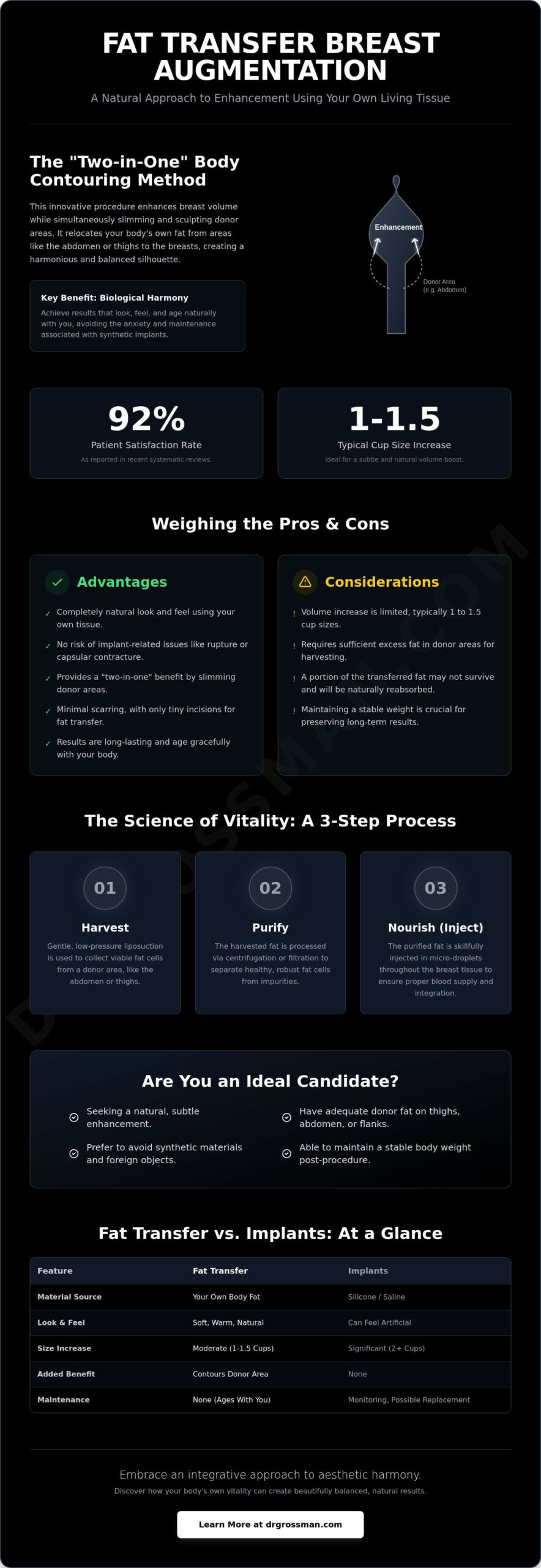
You deserve to feel empowered by your choices, knowing that a subtle increase in volume can also mean a more contoured frame through localized liposuction. We’ll explore how this procedure supports your body’s natural harmony while typically delivering a volume increase of one to one and a half cup sizes. This guide provides a clear, compassionate overview of the latest clinical data, including the 92% patient satisfaction rate reported in recent systematic reviews. You’ll learn exactly how fat grafting can nourish your confidence and help you achieve a beautifully balanced, natural result that aligns with your whole-body wellness goals.
Key Takeaways
- Understand how this “two-in-one” contouring method uses your own vitality to nourish breast volume while slimming donor areas.
- Evaluate the fat transfer breast augmentation pros and cons to see how the warmth and softness of real tissue compare to traditional synthetic options.
- Learn about the purification stages that separate healthy adipose cells from impurities to ensure your body’s natural healing intelligence is supported.
- Determine your candidacy for natural enhancement based on your aesthetic goals and the vital role of weight stability in maintaining your results.
- Explore an integrative approach to beauty that emphasizes long-term wellness and avoids the anxiety often associated with foreign objects in the body.
The Evolution of Natural Breast Augmentation: Why Choose Fat Transfer?
Fat transfer breast augmentation represents a significant departure from conventional surgical philosophies. Instead of introducing synthetic materials into your delicate tissues, this method utilizes your own living cells to achieve a more proportional silhouette. It’s essentially a two-in-one body contouring strategy. We harvest adipose tissue from areas where it’s less desired, such as the abdomen or thighs, and relocate it to the breasts. This process supports your body’s natural intelligence by working with what you already possess, rather than fighting against your biology with foreign objects.
Choosing this path means embracing a more holistic view of enhancement. For many, the anxiety surrounding silicone or saline “foreign materials” is a primary motivator. By opting for fat transfer, you eliminate the risk of implant-related issues while simultaneously refining your overall body contour. It’s a sophisticated way to nourish your self-confidence while respecting your body’s long-term health and vitality.
The Aesthetic Shift Toward Biological Harmony
The trends of 2026 show a clear preference for “stealth” procedures. The goal is no longer a dramatic, artificial change that announces itself to the world. Instead, women are seeking integrative beauty that looks and feels completely natural. This shift is rooted in a desire for biological harmony; patients want results that age gracefully alongside them. There is a profound psychological peace of mind that comes from knowing your enhancement is composed entirely of your own tissue. It removes the “otherness” of traditional surgery, replacing it with a sense of empowerment and agency over your own form.
Fat Grafting vs. Implants: A Quick Overview
When you weigh the fat transfer breast augmentation pros and cons, the fundamental difference lies in the source of the volume. Implants represent an addition of external material, which requires a lifetime of monitoring for silent ruptures or capsular contracture. In contrast, fat grafting is a relocation of your own volume. Because the tissue is autologous, it integrates into the breast as living tissue. You don’t have to worry about the maintenance or replacement cycles that come with synthetic options. While implants can offer a more dramatic size increase, fat transfer provides a softness and warmth that synthetic materials simply cannot replicate. This sets the stage for a deeper exploration of how this natural approach aligns with your specific aesthetic goals.
The Science of Vitality: How Autologous Fat Grafting Works
Understanding the biological foundation of this procedure helps demystify how your body integrates new volume. It is not a simple mechanical filling; it is a delicate transfer of living energy. The process begins with gentle harvesting through advanced liposuction. We select donor sites where your body naturally stores excess vitality, such as the abdomen, thighs, or flanks. This initial step allows us to refine your overall shape while gathering the building blocks for your enhancement. By using specialized, low-pressure cannulas, we protect the integrity of the adipose cells to ensure they remain viable for their new home.
Once harvested, these cells enter a critical purification stage. We use centrifugation or sophisticated filtration to separate healthy, robust fat cells from unwanted fluids and impurities. This step is essential because only the most resilient cells can successfully integrate into the breast tissue. When considering fat transfer breast augmentation pros and cons, the success of the procedure often hinges on this meticulous preparation. High-quality cell selection supports your body’s natural healing intelligence, allowing for a more predictable and harmonious outcome. If you are curious about how these techniques might benefit your specific goals, exploring an integrative approach to body contouring can provide much-needed clarity.
The Three-Step Process: Harvest, Purify, and Nourish
The final stage is the art of placement. We utilize a “micro-droplet” injection technique, which involves depositing tiny amounts of fat in multiple layers of the breast tissue. This method is vital because each individual cell needs to be in close proximity to a blood supply. Your body must “nourish” these new arrivals through a process called revascularization. By creating a seamless, soft breast contour through precise placement, we ensure the new tissue feels like a natural extension of your own body.
Optimizing Fat Survival and Longevity
The longevity of your results depends heavily on how well the transferred cells survive the transition. It is normal for the body to naturally reabsorb about 30% to 50% of the injected volume during the first few months. This is why we sometimes perform a subtle “over-fill” to account for this biological adjustment. Factors like your nutritional status and local blood flow play a major role in how much fat “stays.” Once the cells establish a stable blood supply, they behave just like any other fat cells in your body. Adipose viability serves as the essential foundation for long-term, living results that age with you.
The Comprehensive Pros and Cons of Fat Transfer Breast Augmentation
Evaluating the fat transfer breast augmentation pros and cons requires a look at both the physical sensation and the surgical reality. One of the most profound benefits is the tactile experience. Unlike synthetic implants, which can sometimes feel cool to the touch or noticeably firm, transferred fat is living tissue. It possesses the natural warmth and softness of your own body because it integrates completely into the breast architecture. This biological harmony ensures that the results don’t just look natural; they feel indistinguishable from your original tissue.
This procedure also offers a unique “dual benefit” for your silhouette. To gather the necessary volume, we perform liposuction on donor areas like the abdomen or thighs. This allows us to slim and contour one part of your body while simultaneously enhancing the bust. It’s a holistic approach to reshaping that works with your existing vitality. Additionally, because the fat is delivered through tiny injection points rather than large surgical incisions, you avoid the significant scarring often associated with traditional implant placement. These small marks typically fade into the natural skin texture over time.
The Advantages: Why Patients Choose Natural
Many women choose this path to avoid the long-term maintenance cycles of synthetic materials. There’s no risk of capsular contracture, a condition where the body creates a tight wall of scar tissue around a foreign object. You also don’t have to worry about “bottoming out” or the weight of an implant stretching the skin over decades. Once the transferred fat establishes a blood supply, it becomes a permanent part of your anatomy. This allows for incredibly precise sculpting, as we can place small amounts of fat in specific areas to correct asymmetry or refine the upper pole of the breast with artistic detail.
The Limitations: Setting Realistic Expectations
While the benefits are significant, it’s vital to maintain realistic expectations regarding size. Fat transfer is ideal for those seeking a modest enhancement, typically providing a 0.5 to 1.5 cup size increase per session. If you desire a more dramatic change of two or more cup sizes, you might consider traditional implants or a TUBA breast augmentation. Success also depends on having adequate donor fat; very lean patients may not have enough “biological currency” to achieve their desired volume. Finally, while modern imaging can easily distinguish fat calcification from other health concerns, it’s a possibility that we discuss to ensure you feel fully informed and empowered in your decision.
Navigating the Decision: Are You a Candidate for Natural Augmentation?
Deciding if this procedure is right for you requires a thoughtful look at your unique biology. The ideal candidate typically seeks a modest, graceful enhancement rather than a dramatic transformation. Because we use your own living tissue, you must have enough “donor fat” available to achieve your desired volume. This is the biological currency of the procedure. When weighing the fat transfer breast augmentation pros and cons, it’s also vital to consider your weight stability. Since transferred fat cells behave like the cells in their original location, significant weight fluctuations can alter your results. Maintaining a steady weight helps protect the investment you’ve made in your silhouette.
For patients with very low body fat, the decision becomes more nuanced. If you don’t have sufficient adipose tissue in the abdomen or thighs, achieving a noticeable increase in breast volume can be challenging. We always encourage a holistic self-assessment. Are you looking for a subtle refinement that honors your body’s natural lines, or are your goals better met by other methods? Understanding these surgical realities ensures that you feel confident and empowered as you move forward. If you’re ready to see how these principles apply to you, we invite you to schedule a personalized consultation to discuss your path toward natural harmony.
Physical Requirements and Donor Site Health
The health of your donor sites is just as important as the breast area itself. High-quality adipose tissue is often found in the abdomen, flanks, or outer thighs. We also evaluate the skin elasticity of your breasts. Think of the skin as the “envelope” for the new volume; it must be supple enough to accommodate the graft while maintaining a smooth contour. Our approach involves looking at your whole-body health, ensuring your system is prepared to nourish and support the new tissue during the recovery phase.
The Consultation: Questions to Ask Your Surgeon
Your consultation is a time to demystify the process and build trust. It’s essential to work with a surgeon who views the body as an integrative system rather than a collection of parts. You should feel comfortable asking specific questions to ensure the approach aligns with your needs:
- How many sessions will I likely need to reach my aesthetic goal?
- What is your typical fat survival rate for patients with my body type?
- How will my donor sites be contoured during the harvesting process?
- What steps do you take to support the body’s natural healing intelligence?
For a deeper dive into these concepts and how they relate to volume restoration, you can explore our Ultimate Guide to Fat Grafting. This resource can help you prepare for your visit and ensure you’re asking the right questions for your long-term wellness.
The Dr. Grossman Philosophy: An Integrative Approach to Aesthetic Harmony
True beauty is never an isolated event. It’s a reflection of your body’s overall vitality and internal balance. Dr. Grossman’s approach to enhancement is rooted in this integrative philosophy, ensuring that every surgical step supports your system’s natural healing intelligence. When we evaluate the fat transfer breast augmentation pros and cons, we see more than just a shift in volume; we see an opportunity for biological harmony. By choosing your own living tissue, you’re opting for a solution that ages gracefully with you, maintaining vital functions and natural softness for a lifetime. This commitment to long-term prevention over quick fixes is what defines our patient-centered care.
Our methodology focuses on supporting the body’s ability to nourish and protect the newly placed cells. We don’t just perform a procedure; we guide you through a comprehensive journey that respects your unique physiology. This clinical authority is always balanced with a compassionate, mentor-like style that aims to alleviate the anxiety often associated with surgery. You’ll find that our focus on whole-body health creates a proactive atmosphere where you feel empowered and informed at every stage of your transformation.
Beyond the Surgery: Supporting Your Results
The weeks following your procedure are a vital window of time for your body to integrate the new volume. Supporting a successful “fat take” requires a proactive approach to your internal environment. Proper hydration and nutrient-dense foods help optimize the bioavailability of the resources your body needs for revascularization. It’s also essential to protect the newly transferred cells from external stress. Consider these key steps during your early recovery:
- Maintain a diet rich in healthy fats to support cell membrane integrity and overall vitality.
- Prioritize hydration to ensure efficient nutrient delivery to the breast tissue.
- Avoid any direct pressure or restrictive clothing on the breasts for the first few weeks.
- Focus on gentle movement to support circulation without straining the donor or graft sites.
We view the recovery process as a dedicated partnership between surgeon and patient where your lifestyle choices nourish the final outcome. Volume typically stabilizes after three to six months, and during this time, we’re here to support your body’s natural healing rhythm.
Your Journey Toward Natural Rejuvenation
A methodical, personalized approach is the only way to achieve results that are both beautiful and trustworthy. We lean on decades of research to provide a path that avoids the “overly augmented” look in favor of subtle, proportional refinement. This clinical grounding provides the peace of mind you deserve, knowing that your care is in the hands of a practitioner who values your quality of life as much as your aesthetic goals. You aren’t just seeking a change in appearance; you’re seeking a way to feel more at home in your own skin. If you’re ready to explore how this natural approach can enhance your silhouette, we invite you to schedule a consultation to discuss your natural breast augmentation journey.
Embracing Your Natural Vitality and Aesthetic Balance
Dr. Grossman brings decades of expertise in autologous fat grafting and pioneering techniques for optimized fat survival to every procedure. Our focus remains on whole-body wellness, ensuring your results are as healthy as they are beautiful. If you’re ready to explore how this methodical and compassionate approach can nourish your self-image, we’re here to guide you. Begin your journey toward natural aesthetic harmony with a personal consultation. You deserve an enhancement that feels like a true extension of your own vitality and unique silhouette.
Frequently Asked Questions
How long does fat transfer breast augmentation last?
Once the transferred cells integrate into your breast tissue and establish a stable blood supply, the results are considered permanent. These cells become a living part of your anatomy and will naturally age with you over time. While some initial volume loss occurs during the first few months as the body adjusts, the fat that remains will stay for a lifetime, provided you maintain a stable weight to support your body’s natural harmony.
Can I breastfeed after a fat transfer procedure?
Most women can successfully breastfeed after this procedure because the fat is typically injected into the subcutaneous tissue and muscle layers, avoiding the milk ducts and glands. This technique respects your body’s vital functions and natural healing intelligence. It’s always best to discuss your future family plans with your practitioner to ensure the most protective and supportive approach for your long-term wellness and maternal health.
Will the fat move to other parts of my body after the transfer?
The fat cells do not migrate to other parts of your body once they have been carefully placed and have integrated into the breast tissue. During the initial healing phase, the specialized injection technique ensures each cell is anchored in a way that encourages revascularization. Once this biological connection is established, the fat remains in its new location, behaving exactly like the surrounding natural tissue to maintain a consistent, soft silhouette.
How much weight do I need to have to be a candidate for fat grafting?
Candidacy depends less on a specific number on the scale and more on having sufficient “donor fat” in areas like the abdomen, flanks, or thighs. To achieve a modest enhancement, you generally need enough adipose tissue to harvest and purify for the transfer. During a consultation, we evaluate your whole-body health and fat distribution to determine if your body has the necessary biological currency to support your aesthetic goals effectively.
Is fat transfer safer than traditional breast implants?
Fat transfer is often considered a more integrative alternative because it avoids “foreign object” complications like capsular contracture or silent rupture. When evaluating the fat transfer breast augmentation pros and cons, it’s important to recognize that while it eliminates implant maintenance, it still carries standard surgical risks such as infection or fat reabsorption. This natural approach supports your body’s intelligence by using autologous tissue rather than synthetic materials.
What happens if I lose weight after my fat transfer breast augmentation?
If you lose a significant amount of weight, the transferred fat cells will shrink just like the fat cells in the rest of your body. Because these cells are living tissue, they respond to your body’s metabolic changes and nutritional status. Maintaining a stable weight is the best way to protect and preserve the beautiful, natural volume achieved through your procedure, ensuring your results remain proportional to your frame over the long term.
How many cup sizes can I realistically gain with one fat transfer session?
Patients can realistically expect a volume increase of one to one and a half cup sizes per procedure. This modest gain ensures the skin envelope isn’t over-stressed and that the newly placed cells have the best chance to be nourished by a healthy blood supply. If you desire a more dramatic change, multiple sessions may be required to build the volume methodically while respecting your body’s natural limits and healing capacity.
Does fat grafting interfere with mammograms or breast cancer screening?
Fat grafting does not prevent effective breast cancer screening, though it’s essential to inform your radiologist about the procedure. Modern imaging technology can easily distinguish between natural fat, potential calcifications, and other health concerns. By choosing a practitioner who emphasizes long-term prevention and clinical authority, you ensure that your enhancement supports both your aesthetic desires and your ongoing commitment to whole-body health and vital functions.