Skip to content
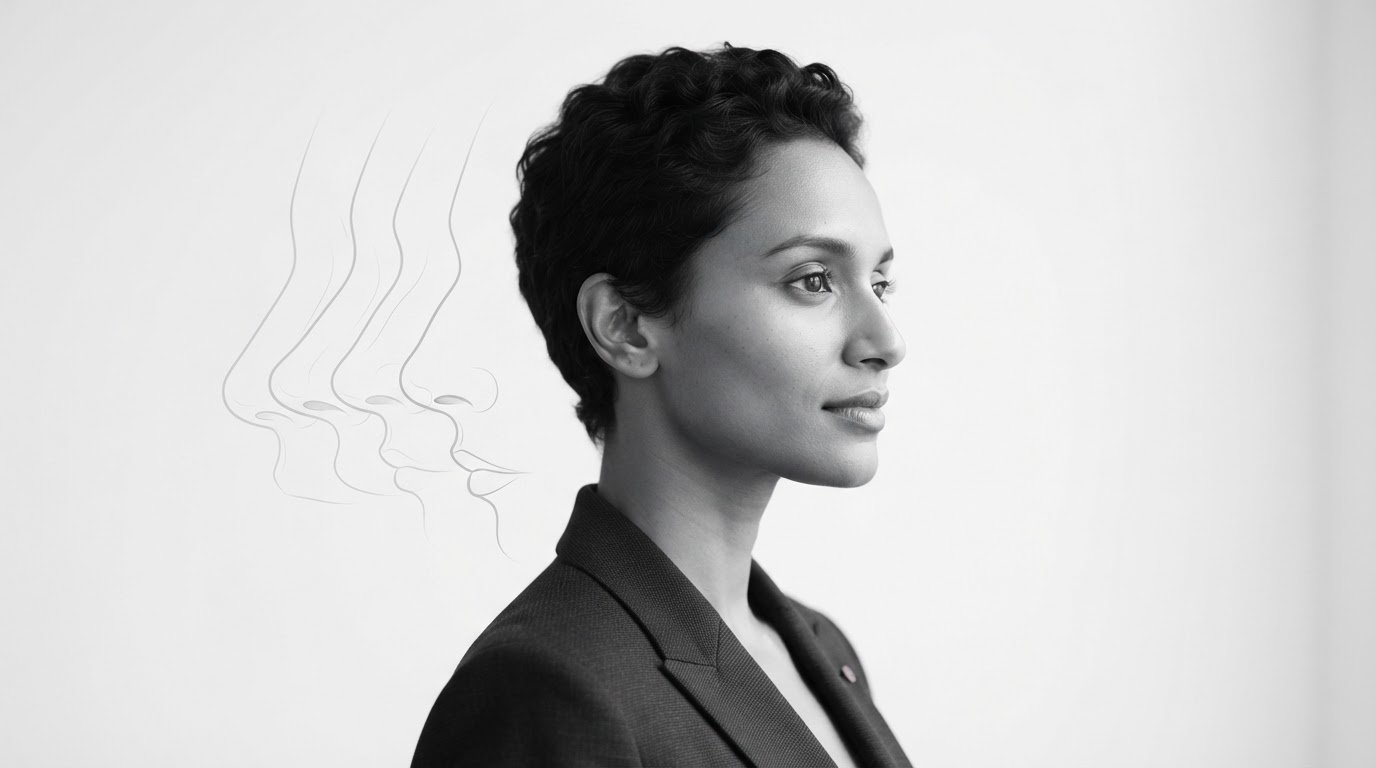
What makes a nose masculine or feminine, and how much of that impression comes from the nose itself? People often associate a straighter, broader bridge or a softer, slightly upturned tip with gender, but those associations are tendencies, not rules. If descriptions seem to conflict, it can help to separate a specific feature you notice from the broader impression someone assigns to it.
A nose doesn’t exist in isolation. Its shape and proportions interact with the forehead, cheeks, chin, and other features, so the same nose may look different from one face to another. No single shape is required to look masculine, feminine, or like yourself.
This article explains features commonly associated with masculine and feminine noses, why perception varies, and how facial balance can matter more than a checklist of traits. If you’re considering rhinoplasty, you’ll also find a practical way to describe your preferences and personal goals without assuming there’s one ideal outcome.
Key Takeaways
- What makes a nose masculine or feminine often reflects cultural perceptions, not fixed rules or measures of identity.
- Bridge width, profile, tip shape, and projection may influence how a nose is perceived, but no single feature defines its appearance.
- Consider how the nose relates to the forehead, cheeks, lips, chin, and jaw before focusing on one detail.
- Describe your preference by naming a feature and the change you’d like, while separating personal goals from pressure to fit a stereotype.
- Rhinoplasty may be an option for people seeking changes to nasal appearance or function, with goals considered in the context of individual anatomy.
What Makes a Nose Look Masculine or Feminine? Start with Perception
People often ask what makes a nose masculine or feminine because they want language for a visual impression or aesthetic preference. The difficulty is that these terms can sound like precise anatomical labels, even though people use them differently. One person may describe a nose as strong because of its bridge, while another may notice its overall proportions or how it relates to the rest of the face.
Here, “masculine” and “feminine” describe patterns some people associate with gender, not medical diagnoses or standards of beauty. They’re shorthand for perception. A person might use one of these words to explain the look they’re drawn to, but the word alone doesn’t reveal which feature they mean or whether a particular change would suit their face.
A masculine or feminine nose is a nose perceived through culturally shaped gender cues; it isn’t a distinct anatomical type or proof of anyone’s identity. Keeping that distinction in mind makes the language more useful and less prescriptive.
Are masculine and feminine noses distinct anatomical categories?
No. Nasal features vary across people rather than sorting neatly into two categories. A nose has multiple characteristics, including its bridge, profile, tip, and projection, and these don’t necessarily appear together in a single “masculine” or “feminine” pattern. Individual anatomy is more varied than a binary label can capture.
Appearance terms also aren’t interchangeable with biological sex, gender identity, or personal expression. Broad discussions of sexual dimorphism in human facial features consider population-level differences, but those broad patterns can’t determine how one person identifies. A nose can’t establish someone’s gender, and no particular shape is required to express it.
Why do people use gendered language to describe noses?
People often reach for familiar visual cues when describing faces. Words like “soft,” “angular,” “refined,” or “strong” can convey an impression quickly, and some people connect those qualities with femininity or masculinity. These associations reflect cultural expectations; the same feature may be read differently by people with different experiences, communities, or ideas about gender.
That’s why these descriptions work best as personal impressions, not universal judgments. A narrower bridge might seem delicate to one person and simply proportional to another. Neither interpretation makes the feature more attractive or correct. If you’re using gendered language to describe a preference, identify the specific detail you mean and what you’d like it to communicate. That gives you a clearer starting point than treating a label as a checklist.
The following sections look more closely at features commonly associated with each impression. The aim isn’t to sort noses into boxes, but to understand the vocabulary, recognize its limits, and make room for individual preferences and facial variation.
Which Nose Features Are Commonly Perceived as Masculine or Feminine?
Descriptions often focus on a handful of visible traits: overall scale, bridge width, the line of the nasal dorsum, and the shape or projection of the tip. Some observers associate a broader, straighter profile with a masculine impression, and softer contours or a slightly upturned tip with a feminine one. These are tendencies in perception, not a formula. The same nose may be read differently depending on its proportions and the face around it.
The nasal dorsum is the bridge’s visible profile, running from between the eyes toward the tip. A straight, gently convex, or subtly concave contour describes its shape; none is inherently masculine or feminine. Width and overall size work similarly. A wider bridge may look prominent on one face and balanced on another, while a smaller nose isn’t automatically perceived as feminine.
| Feature | Common perception, not a rule |
|---|---|
| Overall size and bridge width | A broader or larger-looking nose may be read as stronger; a narrower one may be read as more delicate. |
| Dorsum or profile | A straighter or slightly convex bridge is sometimes associated with masculinity; a softer or gently concave contour with femininity. |
| Tip shape and rotation | A more defined, less upturned tip may read as masculine; a softer or slightly upturned tip may read as feminine. |
| Projection | A more prominent tip may contribute to a stronger impression, but its effect depends on facial proportions. |
These associations aren’t universal, and the features don’t operate independently. A narrow bridge paired with a strongly projected tip may create a different impression than either trait alone. Use the table as vocabulary for discussing appearance, not as a test for categorizing a person or deciding which nose is more attractive.
How can bridge, dorsum, and overall size shape perception?
Width, profile contour, and scale affect how much visual emphasis the nose carries. A noticeable bridge curve, for example, may draw attention in profile, while a straighter contour creates a different line through the center of the face. That visible difference is descriptive, not a judgment about gender. A feature can be prominent without being a flaw, and its effect depends on neighboring features and viewing angle.
How do the nasal tip and projection affect the overall impression?
The tip can appear rounded, defined, broad, or narrow. Its rotation describes whether it points more upward or downward, while projection means how far the nose extends outward from the face. A tip that projects more may seem prominent in profile, but its appearance also depends on the bridge, lips, and chin. No single rotation or tip shape is an ideal for any gender.
If you’re considering a change, describe the specific feature you notice rather than relying only on a gender label. A conversation about individualized rhinoplasty goals can focus on the details that matter to you and how they relate to your face, without assuming a particular feature will create a prescribed result.
Why Facial Context and Individual Variation Matter More Than a Checklist
A nose is perceived as part of a face, not as an isolated set of features. The forehead, cheeks, lips, chin, and jaw all contribute to the face’s overall proportions and profile. As a result, the same nasal shape can seem prominent, subtle, or balanced depending on what surrounds it. A short list of traits can’t reliably describe how a nose will look on every person.
Facial balance depends on the relationships among features, not on one checklist or a single ideal measurement. Instead of asking whether a nose is masculine or feminine, consider what draws your attention and how it relates to the rest of your face.
How does the rest of the face change the way a nose looks?
Imagine two people with a similar nose profile. If one has a more prominent chin, the nose may appear less dominant in profile; if the chin is more recessed, the nose may seem more pronounced by comparison. Cheek and midface proportions can also affect how the nose’s width or length is perceived from the front. These are relationships, not flaws or fixed rules.
Viewing angle matters, too. A feature that stands out in a side view may appear less noticeable from the front, while lighting and expression can change visible contours. That’s why a single photograph or isolated feature may not capture how someone experiences their face as a whole. Considering facial harmony means looking at how nasal proportions relate to surrounding features.
Do culture, ancestry, and identity influence nose ideals?
Ideas about beauty shift across communities and generations, shaped by personal experience and the images and messages people encounter. A nose shape praised in one setting may not be the ideal in another. Even within the same community, people can have different preferences. Cultural ideals can influence how a feature is described, but they don’t dictate what any individual should want.
Ancestry can be part of a person’s identity and family history, but it isn’t a dependable guide to their aesthetic goals. People with shared ancestry may have different nasal anatomy, and people with different backgrounds may have similar features. Avoid using ethnicity as shorthand for a particular nose shape or assuming that someone wants to preserve or change a feature for a specific cultural reason.
Your perspective matters most. If you’re thinking about a change, describe what you notice in neutral, specific terms: perhaps the profile feels prominent to you, or the relationship between your nose and chin is what you’d like to discuss. Then consider whether that preference feels personally meaningful or comes mainly from pressure to match a gendered ideal. This keeps the conversation grounded in your face, priorities, and sense of self.

How to Describe Your Nose Goals Without Relying on Stereotypes
It can be hard to turn a broad impression into a clear request. You don’t need to decide whether your nose looks masculine or feminine before considering a change. Instead, name the feature you notice, describe what you’d like to be different, and consider how that preference fits your face and priorities.
What questions can help clarify your aesthetic preferences?
Before a conversation about rhinoplasty, take time to consider what matters to you. These questions can help you find specific language without treating gendered descriptions as a checklist:
- Identify the feature. Is your attention drawn to the bridge, profile, tip, width, or another aspect of your nose?
- Describe the change you want. Would you prefer a softer contour, a more defined tip, or a subtle refinement? Use your own words rather than relying only on labels like “masculine” or “feminine.”
- Consider what you want to preserve. Which features feel like you, and how would you like the nose to relate to your cheeks, lips, chin, and overall facial balance?
You might be seeking a small adjustment, a different sense of balance, or another personal goal. There’s no need to force that preference into a gender stereotype. Ask yourself whether it reflects what you genuinely want or pressure you’ve absorbed from other people, images, or beauty ideals. Your answer can help keep the conversation centered on your priorities.
How can reference images support a more useful discussion?
Reference images can help communicate visual qualities that are difficult to describe. Rather than choosing one idealized face as a template, gather a few examples that show different features or profiles. For each, note exactly what appeals to you: perhaps the bridge contour in one image, the tip definition in another, or how a nose appears in relation to the rest of the face.
Use the images as conversation prompts, not instructions to reproduce someone else’s face. People have different anatomy and facial proportions, so a feature that looks a certain way in a photograph may not translate identically to another person. Images can clarify your preferences, but they can’t promise a matching result.
A thoughtful surgical discussion should include more than appearance. Bring up breathing concerns or other aspects of nasal health, and make space to understand relevant risks and what goals are realistic for your individual anatomy. Rhinoplasty may be an option for people who choose to explore changes to nasal appearance or function, but no specific gendered look or photographic outcome can be guaranteed. Clear priorities help make the conversation more personal and informed.
If you’re considering a change, discuss your rhinoplasty goals in terms of the features you notice, what you hope to preserve, and the questions you want answered.
How Rhinoplasty Can Address Individual Nose Goals
Rhinoplasty may be considered by people who want to discuss a change to nasal appearance or function. It isn’t a way to meet a universal definition of a masculine or feminine nose. Instead, the discussion can begin with your priorities and consider how they relate to your anatomy, nasal health, and the rest of your face.
If you’ve been thinking about what makes a nose masculine or feminine, you don’t need to settle on a label before discussing a concern. You might want to talk about a profile contour, a feature that draws your attention, or breathing. The aim is to understand what matters to you and whether there are options that align with your goals, along with their limitations.
What can a rhinoplasty consultation help clarify?
A consultation can give you time to explain what you hope to change, what you’d like to preserve, and any concerns about nasal health or breathing. The discussion can also consider relevant anatomy and how your priorities fit within your facial proportions. This helps ground aesthetic preferences in your individual features rather than a generalized template.
It’s also a time to discuss possible approaches, risks, and what may not be achievable. Results and recovery vary by individual, and photographs or reference images can’t guarantee that a particular appearance will be reproduced. Understanding likely limitations supports thoughtful decisions, whether you decide to proceed, continue considering your options, or not pursue surgery.
When might it help to explore rhinoplasty?
You might explore a consultation if you’ve reflected on your goals and would value expert guidance about whether they’re realistic for your anatomy. You don’t need to describe your preferences as masculine or feminine. Plain language, such as “I’d like to discuss this profile feature” or “I want to understand how appearance and breathing relate,” is enough to begin a useful conversation.
For a considered next step, write down your main goals, what you want to keep unchanged, and questions about health, risks, and limitations. Learning how to evaluate a plastic surgeon can also help you prepare for an informed discussion. Reading and asking questions doesn’t commit you to surgery. It can simply help you decide whether a personalized rhinoplasty discussion is right for you.
Let Your Own Priorities Guide the Next Step
There’s no need to settle on a label or make a decision about surgery today. Begin by noticing what feels important to you, what you’d like to preserve, and what questions would help you feel informed. That reflection can make a future conversation more useful, whether your interest is aesthetic, related to breathing, or simply a desire to understand your options.
Understanding what makes a nose masculine or feminine can offer language for describing impressions, but it shouldn’t dictate what your face ought to look like. If you choose to explore a change, Dr. Leonard Grossman offers rhinoplasty, and chin augmentation may also be relevant to a broader discussion of facial balance. A personalized conversation can help you consider your goals without treating any one look as a requirement.
To take the next step, explore rhinoplasty and facial harmony with Dr. Leonard Grossman. Your preferences deserve thoughtful consideration, and the choice of whether to proceed is yours.
Frequently Asked Questions
Are masculine and feminine noses biologically different?
There isn’t a strict biological divide that sorts noses into masculine and feminine types. Nasal anatomy varies across individuals, and some facial traits may differ on average across populations without applying to every person. These descriptive labels can help discuss appearance, but they can’t establish someone’s sex, gender, or identity. For an individual, features such as bridge shape and tip structure are best understood as part of their unique anatomy.
What nose features are commonly perceived as masculine?
A straighter or broader bridge, a more defined profile, and a less upturned or more prominent tip are sometimes described as masculine cues. These impressions depend on the combination of features, not any one trait. One person may notice the profile line first, while another focuses on the nose’s scale relative to the cheeks. These are common associations, not requirements or measures of attractiveness.
What nose features are commonly perceived as feminine?
Some people associate a narrower-looking bridge, softer contours, or a slightly upturned tip with a feminine impression. That doesn’t mean these features are exclusive to women or necessary to look feminine. If you’re trying to describe a preference, identify the detail itself, such as a gentler profile curve, rather than assuming a gender label fully explains what you want. Preferences differ, and no single shape is the standard.
Can a nose look masculine or feminine depending on the rest of the face?
Yes. A nose’s perceived proportions can shift with the forehead, cheeks, lips, chin, and jaw. For example, the same profile may appear more prominent alongside a smaller chin and less so alongside a more prominent chin. Photos can also change impressions through camera distance, angle, and lighting. If comparing images, use similar views and remember that a photograph can’t show how every feature relates in person.
Does ethnicity determine whether a nose looks masculine or feminine?
No. Ethnicity doesn’t determine how a person’s nose will be perceived, what their aesthetic preferences are, or which features they value. People with the same heritage can have varied anatomy and personal ideals. Cultural expectations may influence beauty standards, but they don’t predict an individual’s goals. It’s more respectful and useful to describe the feature someone wants to discuss than to infer preferences from their background.
Can rhinoplasty make a nose look more masculine or feminine?
Rhinoplasty may be considered by someone seeking a change in nasal appearance or function, and goals can include qualities they personally associate with a masculine or feminine look. A particular impression or photographic match can’t be guaranteed. A discussion should account for individual anatomy, nasal health, priorities, risks, and limitations. If breathing is a concern as well as appearance, mention it so both parts of the goal can be considered.
How do I explain my nose goals without following gender stereotypes?
Start with what catches your attention, then name the change you’d like and what you want to preserve. For example, you could say, “I’d like to discuss the bridge in profile, but keep the overall character of my nose.” Bring reference images to point out specific qualities, not to request an exact copy. You can also ask how a proposed change relates to your facial proportions and nasal health.