Skip to content
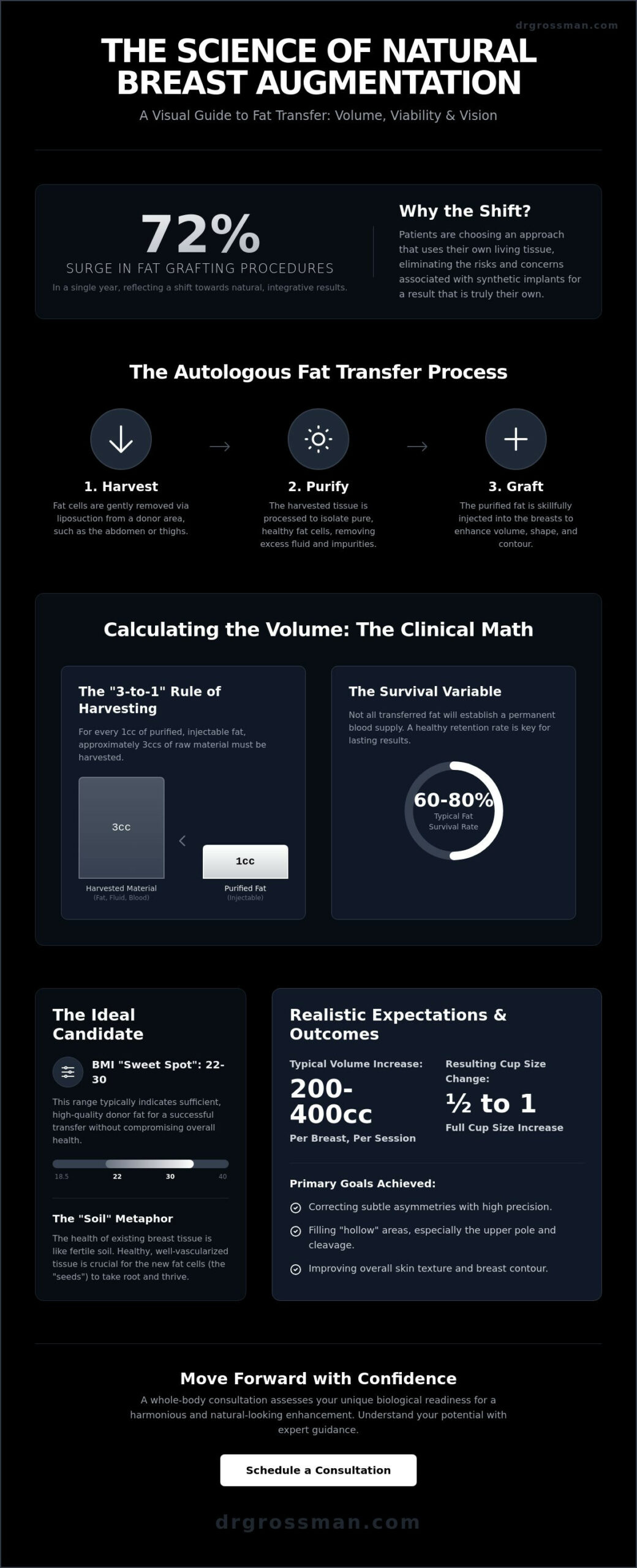
Did you know that while interest in traditional implants has shifted, the number of women choosing breast augmentations using fat grafting has surged by 72% in a single year? It’s natural to feel a blend of excitement and uncertainty when considering this integrative approach to body contouring. You want a fuller silhouette that feels like you, but the most common question remains: how much fat is needed for breast transfer to achieve a visible difference?
We understand the anxiety that comes with conflicting information online and the fear that you might not have enough donor fat to support your vision. This guide provides the clinical clarity you need to understand the precise volume requirements and the health factors that determine your candidacy. We’ll preview the realistic math behind fat survival rates, which typically range from 60% to 80%, and explain how we can support your body’s natural healing intelligence for a beautiful, lasting result. By looking at the synergy between donor quality and tissue receptivity, you can move forward with confidence and agency in your aesthetic journey.
Key Takeaways
- Learn why the “3-to-1” rule is essential for calculating how much fat is needed for breast transfer to ensure a natural volume increase that respects your body’s proportions.
- Understand why a BMI between 22 and 30 is often the “sweet spot” for providing the high-quality donor fat necessary to nourish and sustain a successful graft.
- Discover the “soil” metaphor and how the health of your existing breast tissue determines the long-term survival and integration of the transferred cells.
- Explore how an integrative recovery plan, emphasizing hydration and specific nutrients, supports the vital process of angiogenesis to protect your new silhouette.
- Move beyond the tape measure to understand how a whole-body consultation assesses your biological readiness for a harmonious and natural-looking enhancement.
Understanding the Science of Autologous Fat Transfer to the Breasts
The journey toward a more harmonious silhouette begins with understanding the biological elegance of autologous fat transfer. Unlike synthetic alternatives, this procedure is a two-stage cycle of harvesting and grafting that uses your own living tissue to nourish and enhance your form. We first carefully harvest fat cells through gentle liposuction from donor areas like the abdomen or thighs. These cells are then purified before being grafted into the breast tissue. This integrative approach ensures that your body recognizes the material as its own. It eliminates the risk of “implant illness” or the anxiety often associated with foreign objects in the body. It’s a method that supports your whole-body health while achieving your aesthetic goals through your body’s own resources.
The Biological Advantage of Living Tissue
When we transfer fat cells, or adipocytes, we’re not just moving volume; we’re also transferring the regenerative cells found within the fat tissue. Once these cells are successfully grafted, they behave exactly like the surrounding tissue. They respond to your body’s natural rhythms, including weight changes and aging. Clinical data from 2024 suggests that while some fat is naturally reabsorbed, a significant portion integrates permanently. This creates a soft, warm, and natural feel that synthetic materials simply cannot replicate. By supporting the body’s natural healing intelligence, we allow these new cells to establish a blood supply and thrive as a permanent part of your anatomy.
Realistic Expectations for Volume and Shape
Understanding how much fat is needed for breast transfer requires a shift in perspective from “size” to “proportion.” This procedure is designed for a modest, natural enhancement rather than an extreme transformation. Most patients can expect an increase of about half to one full cup size per session. While every body is unique, many successful procedures utilize between 200cc and 400cc of purified fat per breast. The amount we can safely transfer is often limited by your existing skin elasticity. If the breast tissue is too tight, it cannot accommodate a large volume of fat without compromising the blood supply the new cells need to survive.
Fat grafting is particularly effective for several specific goals:
- Correcting subtle asymmetries between the breasts with high precision.
- Filling in “hollow” areas near the cleavage or the upper pole of the breast.
- Improving the overall contour and texture of the skin.
Because fat is a liquid medium during injection, it allows for precise sculpting that a fixed-shape implant cannot offer. This precision helps us create a balanced look that aligns with your unique biological blueprint. By assessing how much fat is needed for breast transfer during a thorough consultation, we look at your biological readiness rather than just a target number. This ensures the results are both beautiful and sustainable for your long-term wellness.
Calculating the Volume: How Much Fat is Actually Needed?
When determining how much fat is needed for breast transfer, we must look beyond a simple number on a syringe. A successful outcome depends on the “3-to-1” rule. This principle explains that for every 1cc of purified fat we plan to graft, we typically need to harvest 3ccs of raw material through liposuction. This discrepancy exists because the harvested material contains tumescent fluid, blood, and broken lipid cells that aren’t suitable for grafting. To achieve a harmonious result, we generally aim for an injectable volume of 200cc to 400cc per breast. This range allows us to respect the biological limits of your tissue while providing a visible, natural enhancement.
One of the most critical aspects of this procedure is accounting for the “Survival Variable.” The body naturally resorbs a portion of the transferred fat as it works to establish a new blood supply. A clinical report on fat injection volumes indicates that while averages vary, patients often retain about 60% to 80% of the volume. We don’t “over-fill” the area to compensate for this potential loss. Doing so creates excessive pressure that can lead to fat necrosis, where the cells fail to thrive and instead form firm, uncomfortable lumps. It’s better to support the body’s natural healing intelligence with a precise, conservative volume than to overwhelm the delicate environment of the breast.
From Liposuction to Injection: The Purification Process
The integrity of the grafted cells is the foundation of your results. During the purification stage, we gently separate the healthy adipocytes from unwanted oils, blood, and lidocaine used during the harvest. This ensures that only the most viable, nutrient-rich cells are introduced to their new home. Fat purification is the critical step for ensuring cell viability and long-term integration into the body. By using only “pure” fat, we reduce the risk of inflammation and optimize the chances of a successful “take.”
Cup Size Conversions in Fat Grafting
If you’re wondering how these volumes translate to your wardrobe, a general guide is that 150cc to 200cc of purified fat typically equals one full cup size increase. However, your current breast tissue density and skin elasticity act as a natural limit. If the tissue is very firm or the skin is tight, we can only inject a specific amount before the pressure becomes too high for the cells to survive. For those seeking more significant changes, we often recommend a “Step-Up” approach. This involves achieving your goals through multiple sessions, allowing the skin to expand and the blood supply to strengthen between each stage. If you’re curious about your own biological readiness, a consultation for fat grafting to the breasts can help define a personalized plan for your unique anatomy.
Evaluating Donor Sites and Body Mass Index (BMI)
Identifying where your living treasure resides is just as important as the volume itself. When we assess how much fat is needed for breast transfer, we look for “golden” donor sites where fat is naturally more stubborn and resilient. The abdomen, flanks, and thighs are the preferred regions because the fat cells in these areas tend to be more stable. This stability is vital because it increases the likelihood that the cells will successfully integrate into their new environment. For many women, the dual benefit of slimming a donor area through liposuction while augmenting the breasts is the most rewarding part of this integrative journey.
Your Body Mass Index (BMI) serves as a helpful guide for biological readiness. Most practitioners find the “sweet spot” for candidacy falls between a BMI of 22 and 30. This range typically ensures you have enough subcutaneous fat to harvest while maintaining a healthy environment for the grafts to thrive. For more detailed information on candidacy, the Fat Transfer Breast Augmentation guide from the American Society of Plastic Surgeons offers a helpful overview of the typical patient profile. If you fall below this BMI range, you may face the “lean patient” challenge, but this doesn’t necessarily disqualify you from a natural enhancement.
Where Does the Best Fat Come From?
Not all fat is created equal. Fat harvested from the inner thighs often has a different texture and metabolic profile than fat from the lower abdomen. We use a philosophy of “integrative liposuction” to gently sculpt your donor sites while prioritizing the harvest of high-quality adipocytes. If one area doesn’t provide enough volume, we utilize a “fat bank” concept. This involves harvesting smaller amounts from multiple sites like the arms, back, and knees to reach your volume goals. This methodical approach ensures we gather the right amount of purified material without over-harvesting any single area.
Weight Stability and Candidacy
We strongly recommend that you reach your “forever weight” before scheduling your procedure. Because we are transferring living tissue, the results are deeply connected to your metabolic health. If you lose a significant amount of weight after the procedure, the transferred fat cells will shrink along with the rest of your body. Fat cells in the breast will grow or shrink just like fat cells elsewhere in the body. By establishing weight stability first, you protect your investment and allow your body to maintain its new, harmonious proportions. When you’re ready to discuss how much fat is needed for breast transfer for your specific body type, a consultation for fat grafting to the breasts can provide a clear path forward based on your unique biological blueprint.
Factors That Influence Fat Survival and Long-Term Results
Achieving a beautiful result involves more than just a surgical procedure; it requires a partnership with your body’s natural healing intelligence. To understand the long-term outcome, we often use the “soil” metaphor. If the breast tissue is the soil and the transferred fat cells are the seeds, the success of the graft depends entirely on the health of the environment. Even when we precisely determine how much fat is needed for breast transfer, the “take” rate is influenced by how well your tissue can nourish those new cells. If the internal environment is vibrant and well-oxygenated, the seeds will thrive. If the soil is depleted, the body may resorb more volume than we anticipate.
One of the most vital guidelines for protecting your investment is the “No Pressure” rule. For the first several weeks, the newly transferred fat cells are in a fragile state, relying on the surrounding fluid for nutrients until new blood vessels can reach them. External pressure from tight underwire bras or restrictive clothing can compress these fledgling cells and prevent them from establishing a blood supply. We recommend soft, supportive garments that allow the tissue to breathe and heal without constriction. Similarly, nicotine is a significant obstacle to success. It constricts the tiny capillaries necessary for survival, effectively starving the new grafts of the oxygen they need to integrate. Choosing an integrative path means supporting your body by removing these stressors during the critical healing window.
Nourishing the Graft: Post-Operative Care
The Role of Blood Supply in Fat Survival
The body must perform a biological miracle called angiogenesis, where it grows new blood vessels to reach each individual fat pearl. This is why we use a meticulous injection technique, placing tiny droplets of fat in multiple layers of the breast tissue. This approach maximizes the surface area contact for each cell, ensuring it has the best possible chance to connect to a nutrient source. If you have significant scarring or have undergone previous radiation, the blood supply may be less receptive, which we carefully assess during your consultation. If you’re ready to explore how your unique biology influences how much fat is needed for breast transfer, we invite you to learn more about our approach to fat grafting to the breasts.
The Integrative Path to Natural Breast Augmentation
Choosing a path toward natural augmentation is a significant step in honoring your body’s innate wisdom. When you move beyond the clinical data, you find that a successful outcome depends on a surgeon who views your health through a “whole-body” lens. This perspective ensures that the procedure doesn’t just address a localized desire for volume but supports your overall vitality. By assessing your biological readiness, we can determine how much fat is needed for breast transfer while ensuring the surrounding tissue is healthy enough to nourish the new grafts. For many women, total rejuvenation involves combining this natural volume restoration with a breast lift to address both shape and position in one harmonious session.
Making the decision to move forward with fat grafting is an investment in your long-term health and self-image. It’s a choice that replaces the anxiety of foreign objects with the reassurance of using your own living tissue. During our consultation process, we look past the tape measure to understand your lifestyle, nutrition, and metabolic stability. This thoroughness allows us to create a plan that respects your body’s limitations while optimizing the potential for a beautiful, lasting result. We want you to feel empowered by the science and hopeful about the silhouette we can achieve together.
Beyond the Surgery: A Partnership in Health
Our approach differs from high-volume “plastic surgery mills” because we prioritize a long-term partnership over a single transaction. We believe that monitoring your results as they “live” and integrate into your body is essential for maintaining your silhouette. This commitment to care is a cornerstone of The Ultimate Guide to Fat Grafting NYC: Natural Rejuvenation and Volume Restoration. We encourage regular follow-ups to observe how your lifestyle and hydration continue to support the transferred tissue. This integrative philosophy ensures that your enhancement remains a vibrant and healthy part of your anatomy for years to come.
Next Steps: Your Personal Volume Assessment
Preparing for your initial consultation is an empowering part of the journey. Before your visit, take a moment to self-assess your potential donor sites. Look for areas of “stubborn” fat on the abdomen, flanks, or thighs that have remained stable despite changes in your diet or exercise routine. While we will perform the precise measurements, having a sense of your own “fat bank” helps us discuss how much fat is needed for breast transfer during your visit. We also recommend reflecting on your long-term wellness goals and any questions you have about the recovery process.
If you’re ready to find a practitioner who aligns with these values, consult our resource on Choosing an Elite Plastic Surgeon in NYC: An Integrative Buying Guide for 2026. This guide will help you identify a partner who respects the connection between your aesthetic goals and your total body wellness. By choosing a natural approach, you’re supporting your body’s natural healing intelligence and embracing a silhouette that is authentically yours.
Embracing Your Natural Silhouette with Confidence
A successful breast transfer is far more than a simple volume calculation; it’s a biological partnership between your donor sites and your breast tissue. We’ve explored how the 3-to-1 ratio determines how much fat is needed for breast transfer and why supporting your body’s healing intelligence is the key to long-term results. By prioritizing your whole-body health and weight stability, you can achieve a natural-looking enhancement that feels like a true extension of yourself. This integrative path offers a sense of agency and empowerment that traditional synthetic options often lack.
Dr. Grossman is a pioneering expert in autologous fat grafting with over 30 years of experience. He utilizes an integrative approach that prioritizes your natural longevity and employs meticulous, artistic injection techniques for seamless, lump-free results. If you’re ready to take the next step toward a harmonious silhouette, we invite you to Schedule Your Integrative Fat Transfer Consultation with Dr. Grossman. Your journey toward a renewed sense of self begins with a personalized assessment of your unique biological blueprint. We look forward to supporting your path to wellness and beauty.
Frequently Asked Questions
Can I gain weight before surgery to have more fat for the transfer?
Gaining weight specifically for the procedure is generally discouraged because it can compromise the long-term stability of your results. If you intentionally gain weight to increase available donor tissue, those fat cells are biologically programmed to shrink once you return to your natural baseline. It is much more effective to be at a stable “forever weight” so we can accurately assess how much fat is needed for breast transfer based on your sustainable anatomy.
How much of the transferred fat actually stays permanently?
On average, the volume retention rate for fat grafting is approximately 58% after the initial healing phase. While some studies using precise MRI measurements have found retention rates around 46%, most experienced surgeons expect 60% to 80% survival under optimal conditions. Once the fat successfully integrates and establishes a blood supply during the first six months, those living cells become a permanent part of your breast tissue.
What happens to the fat in my breasts if I lose weight later?
Because the transferred tissue consists of living fat cells, they will respond to metabolic changes exactly like the rest of your body. If you lose a significant amount of weight, the fat cells in your breasts will shrink, which may reduce the overall volume of your augmentation. Maintaining a consistent weight is the best way to preserve your new silhouette and support the body’s natural healing intelligence over the long term.
Is there a minimum BMI required for breast fat grafting?
There is no universal minimum BMI, but a range of 22 to 30 is often considered the ideal “sweet spot” for harvesting high-quality donor tissue. Patients with a lower BMI may face the “lean patient challenge,” which requires us to harvest smaller amounts of fat from multiple areas like the thighs, flanks, and back. We focus on the quality and accessibility of your subcutaneous fat rather than just a number on a scale.
Can fat transfer to the breast interfere with mammograms or cancer screening?
Modern digital mammography and the expertise of specialized radiologists allow for a clear distinction between transferred fat and potential health concerns. While fat necrosis is the most common complication, accounting for about 43.7% of all complications, these benign lumps are identifiable during routine screenings. Leading industry organizations support the safety of this procedure, provided you continue regular screenings with a radiologist experienced in reading post-surgical imaging.
How many cup sizes can I realistically gain with one fat transfer session?
Most patients can realistically expect a modest increase of about half to one full cup size per session. This aligns with the 2026 trend where 70% of patients now opt for natural, 1 to 2 cup size increases rather than dramatic changes. If you desire a more significant transformation, we can discuss a staged approach that allows your skin to expand and your blood supply to strengthen between procedures.
What if I don’t have enough fat on my stomach for the procedure?
If your abdomen does not provide sufficient donor tissue, we can harvest fat from other “golden” sites such as the inner thighs, flanks, or the back. This “fat bank” approach allows us to gather the necessary volume by combining smaller amounts from several regions of the body. During your consultation, we will meticulously assess all potential donor areas to determine how much fat is needed for breast transfer to meet your specific goals.
How long is the recovery before I can see my final breast size?
You will typically see your final, stable breast size between three and six months after the procedure. During the first few weeks, some swelling is expected, and the body will naturally resorb a portion of the transferred volume. Once the remaining fat cells establish a permanent blood supply through the process of angiogenesis, your results are considered settled and integrated into your silhouette.