Skip to content
Well-defined calves play a major role in lower-body balance and athletic proportion. For some people, no amount of training produces the shape or volume they want. Genetics, prior injury, or naturally slender legs can make muscle development difficult. In those cases, surgical calf augmentation with an experienced specialist such as Dr. Leonard Grossman becomes an option.
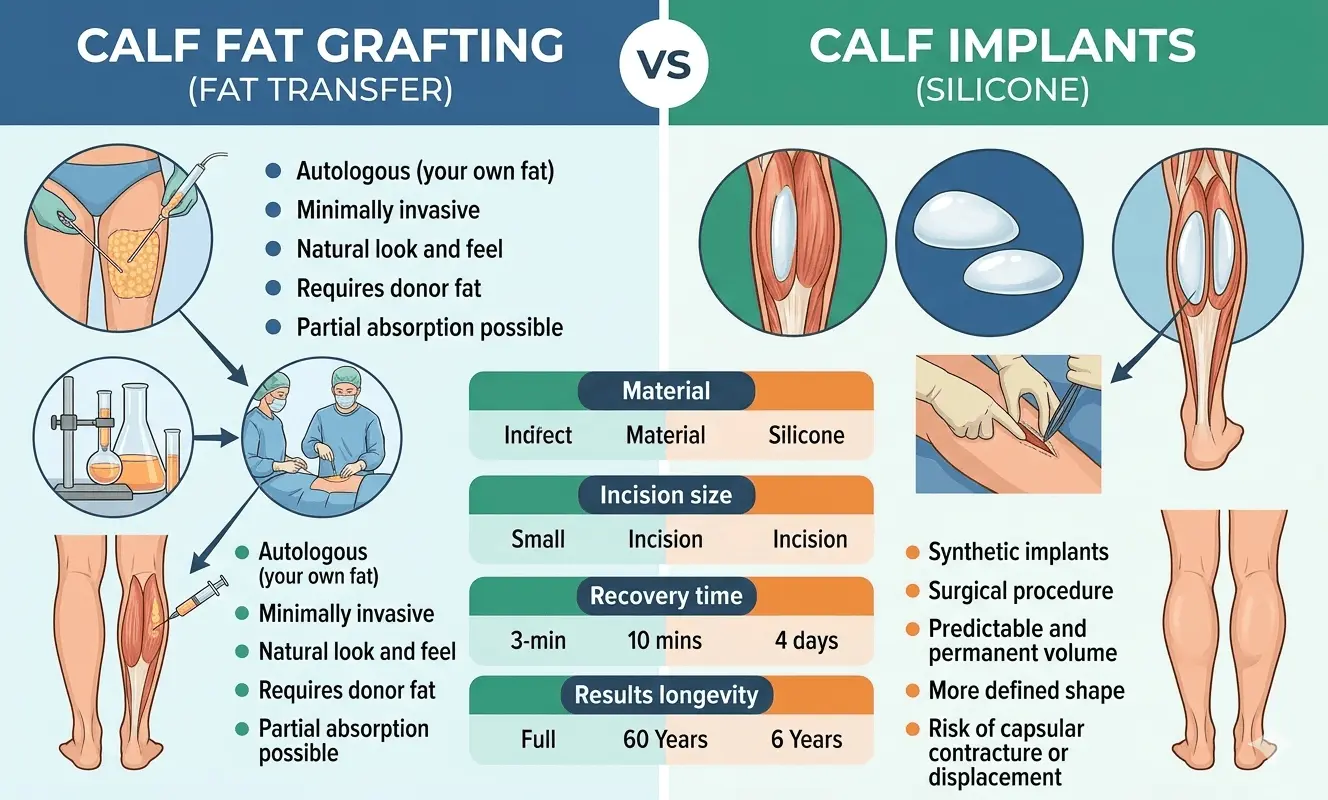
There are two primary approaches: calf augmentation with fat grafting and calf augmentation with silicone implants. While both procedures increase calf size, they differ significantly in technique, safety, recovery, flexibility, and long-term results. Knowing these differences is essential before making a decision.
Overview Of Calf Fat Grafting
Calf fat grafting uses your own living fat cells to enhance lower leg volume and contour. This is also known as autologous fat transfer.
How The Procedure Works
The procedure is performed in several stages:
- Fat Harvesting: Gentle liposuction removes fat from areas such as the abdomen, flanks, or thighs.
- Fat Processing: The harvested fat is carefully purified to preserve viable adipocytes and stem cells while removing impurities.
- Strategic Micro Layered Injection: Purified fat is injected in small, distributed layers throughout the calf to maximize blood supply integration, improve survival, and create smooth, natural contours.
Unlike implants, fat grafting is not about inserting a device. It is about structural sculpting. The fat becomes living tissue once it integrates with the body’s blood supply.
Dr. Leonard Grossman: Inventor And Pioneer Of Calf Fat Grafting
Dr. Leonard Grossman developed calf augmentation with fat grafting in 1995, long before fat transfer became widely adopted in aesthetic surgery. He is the originator of this technique and has performed over 4,500 calf augmentations using fat grafting, representing one of the largest case experiences worldwide.
Key distinctions of his technique include:
- Atraumatic harvesting methods
- Advanced fat purification protocols
- Multi-plane micro grafting placement
- Structural sculpting rather than simple filling
His documented outcomes show greater than 90 percent long-term fat retention and no major complications reported in his calf fat grafting cases. Patients achieve stable, natural, muscle-like results with tissue integration lasting over 30 years.
Another important distinction is flexibility. Dr. Grossman’s method enhances any part of the lower leg, not just the upper calf. This allows for comprehensive contouring and true customization.
Overview Of Calf Implants
Calf implants involve surgically placing solid silicone devices to increase projection.
How Implants Work
A surgical pocket is created, typically through a three-inch incision behind the knee crease. A pre-formed silicone implant is inserted to provide immediate volume. The projection is fixed based on the implant’s shape and size.
While implants can increase calf size, they come with inherent limitations.
Limitations Of Calf Implants
- Size Restrictions
Implants are manufactured in fixed dimensions. Enlargement is limited to available sizes and shapes. - Placement Limitations
Implants are usually positioned in the upper calf region. They cannot effectively contour the entire lower leg. They do not refine ankle taper and offer limited sculpting flexibility. - Movement And Stability Concerns
Because implants are foreign devices, they may shift or rotate. In thinner patients, implants can become visible or palpable. Some individuals report noticeable movement during walking or flexion. - Firmer Feel
Implants may feel firmer compared to natural muscle and fat.
For some patients with extremely low body fat who do not have adequate fat available for transfer, implants may be considered. However, it is important to understand the tradeoffs.
Recovery Comparison
Recovery is often one of the biggest concerns for patients considering calf augmentation.
Fat Grafting Recovery
With calf fat grafting, patients can expect swelling in both the donor and recipient areas, since liposuction and fat transfer are both involved. Downtime is generally moderate, and most patients return to full activity in approximately 10 days. Because no implant is placed, there are no positioning concerns or risks of device shifting during the healing process.
This often provides peace of mind during recovery, as the body is healing its own tissue rather than adjusting to a foreign object.
Implant Recovery
Recovery from calf implants is typically longer and more restrictive. The procedure involves creating a surgical pocket that may affect muscle and fascia, which can increase early discomfort. Patients often face greater activity restrictions and require careful monitoring to prevent implant shifting or displacement.
Overall, implant recovery tends to be more involved and may feel more demanding during the initial healing phase.
Complication Profile
Safety is understandably a top priority.
Fat Grafting
Because calf fat grafting uses your own tissue, there is no foreign body reaction, no implant rejection, and no risk of shifting or displacement. Complication rates are extremely low when the procedure is performed properly and with advanced technique. In Dr. Grossman’s experience of over 4,500 cases, no major complications have been reported.
Once the transferred fat establishes a blood supply, it becomes living tissue that remains stable and integrated with the surrounding structures.
Calf Implants
Calf implants involve the placement of a foreign silicone device, which is associated with a higher relative complication profile. Potential risks include implant displacement, asymmetry, infection, fluid collection known as seroma, capsular contracture, visibility or palpability of the implant, and, in some cases, the need for revision surgery.
While many patients undergo implant surgery without major issues, the presence of a device inherently introduces risks that are not present with autologous fat transfer.
Aesthetic Results Comparison
When evaluating outcomes, patients typically care about how their legs look and feel in real life, not just in photos.
- Material: Fat grafting uses your own fat. Implants use silicone devices.
- Feel: Fat grafting produces a soft, natural feel. Implants are firmer.
- Movement: Fat moves naturally with the body. Implants may feel fixed or shift.
- Enhancement Range: Fat grafting can enhance any part of the lower leg. Implants mostly affect the upper calf.
- Size Flexibility: Fat grafting is highly customizable. Implants are limited to available sizes.
- Longevity: Once integrated, transferred fat is permanent. Implants are long-term but remain device-dependent.
The Key Advantage Of Fat Grafting: Complete Sculpting Control
One of the most important differences is sculpting freedom. Fat grafting allows Dr. Grossman to shape the calf according to the patient’s desired aesthetic. Medial and lateral calf enhancement, ankle transition refinement, asymmetry correction, athletic shaping, and subtle or dramatic increases are all possible.
Because the fat becomes living tissue, results appear natural in both look and motion. The procedure is not restricted by implant dimensions or placement zones.
Which Procedure Is Better?
For patients seeking:
- A natural look and feel
- Enhancement beyond the upper calf
- Lower complication risk
- Greater sculpting flexibility
- Stable, integrated tissue
- Avoidance of foreign devices
Calf fat grafting is often the superior option.
Implants may be appropriate for individuals with extremely low body fat who desire significant size increase and are comfortable accepting the associated risks and recovery demands.
Why Patients Choose Dr. Leonard Grossman In NYC
Dr. Leonard Grossman practices in New York City and is the inventor and leading authority in calf augmentation with fat grafting, as well as other forms of fat transfer.
His credentials include:
- Developer of the original calf fat grafting technique in 1995
- Over 4,500 calf fat augmentation procedures performed
- Greater than 90 percent fat retention rate
- No major complications reported
- Decades of surgical refinement
His philosophy emphasizes symmetry, natural movement, proportional balance, and long-term stability. With offices conveniently located in both Brooklyn and Manhattan, patients benefit from easy access to consultations, ongoing care, and long-term follow-up close to home.
Ready To Take The Next Step Toward Stronger, More Defined Calves?
Both calf fat grafting and calf implants can increase calf size, but they are fundamentally different procedures. Implants provide fixed projection but are limited in flexibility and carry a higher relative risk. Fat grafting offers customized sculpting, a natural feel, stable integration, and exceptional safety when performed by an experienced specialist.
If you are considering calf augmentation in NYC, a personalized consultation with Dr. Leonard Grossman can help determine the best approach for your anatomy and goals. An informed decision begins with expert guidance and a clear understanding of your options.
To see real patient results and stay informed about the latest advancements in fat grafting, connect with Dr. Grossman on Instagram and Facebook.
Enhance your lower leg contour with advanced calf fat grafting—schedule your consultation today.