Skip to content

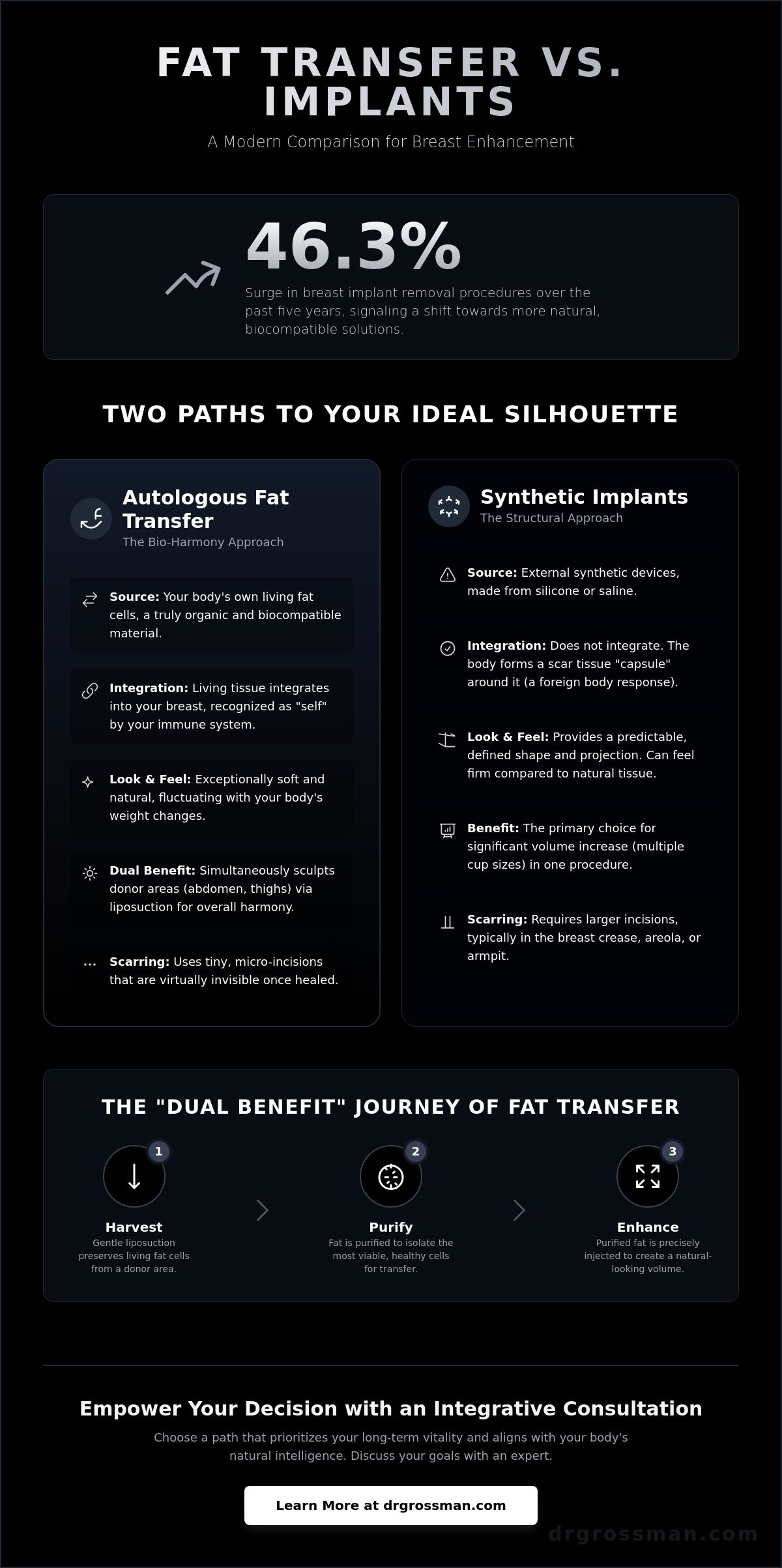
Over the past five years, breast implant removal procedures have surged by 46.3 percent, signaling a profound shift in how women approach their bodies and long term wellness. This trend highlights the growing debate of fat transfer vs implants for breasts as more individuals seek to harmonize their aesthetic goals with their body’s innate biological intelligence.
You likely want to feel more confident in your silhouette, yet you might feel anxious about foreign body reactions or the boxed warnings now mandated by the FDA. It’s natural to feel hesitant about placing a synthetic device in your chest when your priority is whole body health. This guide helps you understand the biological and structural differences between autologous fat grafting and synthetic implants so you can choose a path that nourishes your self esteem without compromising your vitality.
We’ll explore the survival rates of transferred tissue, the latest safety regulations, and how an integrative approach can provide a balanced, scar free result that feels like a true extension of yourself.
Key Takeaways
- Understand how the shift toward biocompatible aesthetic surgery allows you to use your body’s own living resources for a truly natural enhancement.
- Discover the biological differences involved in fat transfer vs implants for breasts, specifically how autologous tissue integrates compared to the body’s response to synthetic materials.
- Learn about the dual benefit of fat grafting, which allows for sculpting donor areas through liposuction while simultaneously supporting a more harmonious bust silhouette.
- Compare the practicalities of recovery and scarring to see how micro-incisions and shorter healing times can protect your daily quality of life.
- Empower your decision making process by identifying the essential factors in an integrative consultation that prioritizes your long term vitality over quick fixes.
The Evolution of Breast Enhancement: Natural vs. Synthetic Approaches
In 2026, the landscape of aesthetic medicine is undergoing a transformative shift toward biocompatible surgery. This evolution reflects a growing collective desire to harmonize our physical goals with our internal health. Rather than simply viewing the body as a canvas to be altered, we are learning to treat it as a complex, living system that thrives on integration. When you weigh the choice of fat transfer vs implants for breasts, you’re participating in a much larger conversation about how your body interacts with the materials placed within it.
Natural breast augmentation focuses on using your body’s own resources, specifically autologous fat, to achieve a more balanced silhouette. This approach aligns with an integrative philosophy that prioritizes the immune system’s stability. Every time a synthetic object enters the body, the immune system initiates a “foreign body response,” attempting to identify and manage the intruder. Deciding between fat transfer vs implants for breasts often comes down to how much you value this biological synergy. By choosing your own tissue, you bypass an adversarial biological reaction, supporting a state of bio-harmony where the new volume is recognized as “self” rather than “other.”
The emotional journey of choosing between these two paths often centers on a search for authenticity. Many women feel a sense of empowerment when they discover they can use their own vitality to enhance their form. Breast augmentation procedures have historically focused on the external result, but the modern path emphasizes how you feel from the inside out. It’s about finding a solution that doesn’t just look natural but functions in tandem with your whole-body wellness.
The Rise of Autologous Fat Grafting
Patients are moving away from traditional synthetic materials because they want a result that feels truly theirs. This rise in autologous fat grafting is driven by the concept of bio-harmony. Fat is a remarkably versatile tool; it doesn’t just provide volume, it can also nourish and optimize the quality of the overlying skin. By harvesting tissue from areas of excess and relocating it to the bust, we support the body’s natural healing intelligence without introducing external risks.
The Traditional Role of Breast Implants
Breast implants remain a choice for those who require significant structural projection or a highly predictable change in cup size. These synthetic options provide a specific architecture that living tissue sometimes cannot replicate in a single session. However, it’s vital to recognize the limitations of these volume-only solutions. They don’t integrate with your biological systems. Instead, they require the body to adapt to their presence, a distinction that many health-conscious patients are now weighing more carefully.
Fat Transfer: Harnessing Your Body’s Vitality for Volume
Choosing fat transfer allows you to harness your body’s own regenerative potential. When evaluating fat transfer vs implants for breasts, it’s essential to understand that fat isn’t just a filler; it’s a living tissue that integrates into your existing anatomy. This biological integration is what creates the soft, warm, and anatomically correct feel that synthetic materials often struggle to replicate. Because the tissue is your own, it fluctuates naturally with your body’s weight and hormonal cycles, maintaining a sense of bio-harmony that evolves with you over time. This makes the debate over fat transfer vs implants for breasts not just about size, but about how you want to live in your skin for the next decade.
The “Dual Benefit” is a cornerstone of this approach. By performing liposuction on areas with excess volume, such as the abdomen, flanks, or thighs, we can sculpt your donor site while simultaneously enhancing the bust. This process supports your body’s natural healing intelligence. Since the transferred cells are recognized as “self,” there is no risk of the inflammatory foreign body reactions often associated with synthetic devices. This harmonious approach ensures that the enhancement feels like a true extension of your physical identity.
The Process of Liposuction and Purification
Success begins with how we treat the living cells during the harvest. We use gentle liposuction techniques designed to preserve the bioavailability and structural integrity of the fat. Once collected, the fat undergoes a meticulous purification process to remove oil, blood, and damaged cells, leaving only the most robust tissue for transfer. We then utilize a micro-droplet injection technique, placing tiny amounts of fat in multiple layers. This detailed method ensures each cell is surrounded by healthy tissue, allowing the body to nourish the new graft with a fresh blood supply.
Long-Term Results and Tissue Health
According to the American Society of Plastic Surgeons, fat transfer offers a unique advantage in skin quality. The regenerative cells within the fat can actually rejuvenate and protect the overlying tissue, often improving texture and elasticity. This long term benefit is something synthetic options can’t provide. As of June 2026, clinical data shows that typically 50 to 70 percent of the transferred fat survives long term, with overall aesthetic success rates ranging between 55 and 80 percent depending on the specific surgical technique and the patient’s individual healing capacity.
Breast Implants: Understanding the Structural Approach
While our previous discussion focused on the living, regenerative nature of fat, breast implants offer a different, structural path to enhancement. When weighing fat transfer vs implants for breasts, it’s helpful to view implants as a precise, mechanical tool. They provide a specific architecture and projection that can be predicted with clinical accuracy. This predictability is often why patients seeking a significant change in cup size or a specific “lifted” look consider them. However, this mechanical precision comes with a unique biological cost: the foreign body response. Because an implant is not autologous tissue, your body’s natural healing intelligence identifies it as an outsider. To protect your vital functions, the immune system creates a fibrous capsule around the device. This is the body’s way of maintaining a healthy boundary between itself and the synthetic material.
Maintenance is a lifelong reality for anyone choosing this structural route. Unlike fat, which integrates and becomes a permanent part of your living tissue, implants are not lifetime devices. The FDA now requires a boxed warning on all implant materials to ensure patients are fully aware of these long term implications. For instance, 2026 safety guidelines recommend screening for silent silicone ruptures via ultrasound or MRI starting 5 to 6 years after your initial surgery, then every 2 to 3 years thereafter. This ongoing vigilance is a necessary part of the commitment required when you choose to integrate synthetic materials into your physical form.
Saline vs. Silicone: An Integrative Comparison
Saline implants consist of a silicone shell filled with sterile salt water. They offer a firmer feel and the peace of mind that the body can safely absorb the filling if a leak occurs. Silicone gel implants, particularly the newer generation of “gummy bear” cohesive gels, mimic the natural density of breast tissue more closely. While they provide a more realistic texture, they require more intensive monitoring to ensure the shell remains intact. Both options necessitate a clear understanding of how synthetic volume impacts your long term whole body health and the structural integrity of the breast pocket.
Risks and Considerations of Synthetic Volume
The body’s protective response can sometimes become overactive, leading to capsular contracture. This happens when the fibrous tissue around the implant tightens, causing discomfort or a change in the breast’s shape. Additionally, many women share concerns regarding Breast Implant Illness (BII). While not a formal medical diagnosis, the systemic symptoms reported by patients are now acknowledged by the FDA. Choosing implants often means accepting a cycle of future surgeries, as the risk of complications like rupture or displacement naturally increases as the device ages. Balancing these structural benefits against the desire for a non adversarial, natural result is a deeply personal part of your wellness journey.
Comparing Fat Transfer vs. Implants: A Practical Framework
Deciding between fat transfer vs implants for breasts requires a clear look at your daily life and long term health goals. This choice isn’t just about the final cup size; it’s about how the procedure integrates with your body’s natural rhythms. In the first week of recovery, fat transfer patients often experience a dual sensation. You’ll feel a deep muscle ache in the donor sites where liposuction occurred, while the breast area typically feels full and slightly tender. In contrast, implant recovery involves more significant chest wall pressure as the body adapts to the structural presence of a synthetic device. While most patients return to light activities within seven to ten days for both procedures, the biological impact on your system differs fundamentally.
Scarring is another practical consideration that favors the integrative path. We utilize micro-incisions for fat grafting, which are so small they often heal without visible traces. Implants, however, require larger surgical incisions to accommodate the device, resulting in permanent scars that require careful management. Longevity also plays a vital role in this framework. As we’ve discussed, fat is a permanent living tissue once the blood supply is established. Implants are medical devices that the FDA advises will eventually need replacement or removal, often within 10 to 15 years, creating a cycle of future surgical commitments.
From a cost benefit perspective, the initial investment for fat transfer is typically higher because it’s essentially two procedures in one. However, it lacks the long term maintenance costs associated with implants. This includes the periodic MRI or ultrasound screenings the FDA recommends starting 5 to 6 years after surgery to detect silent ruptures. By choosing your own tissue, you’re investing in a solution that supports your whole body health without the need for lifelong device monitoring.
Who is the Ideal Candidate for Fat Transfer?
Our “Integrative Checklist” helps determine if your body is ready for fat grafting. The ideal candidate has enough donor fat in areas like the abdomen or thighs to support the desired volume increase. If you’re seeking a subtle, natural enhancement of 0.5 to 1.5 cup sizes and wish to avoid foreign materials entirely, this path aligns perfectly with your goals. It’s a choice for those who prioritize bio-harmony and a soft, anatomically correct feel over dramatic projection.
Who is the Ideal Candidate for Implants?
Implants remain a viable option for patients with very low body fat who lack sufficient donor sites for grafting. If you desire a significant increase in volume or dramatic projection that living tissue cannot provide in a single session, a synthetic approach might be necessary. This is also often the case for patients requiring significant structural correction following major weight loss, where the skin requires the firm support of a cohesive gel device to achieve a balanced shape.
If you’re ready to explore how your own tissue can create a balanced silhouette, you can learn more about fat grafting to the breasts.
The Integrative Path to Your Ideal Silhouette
Selecting the right path for your body is a decision that extends far beyond the immediate visual result. When you evaluate fat transfer vs implants for breasts, you’re choosing a philosophy of care that will stay with you for decades. Dr. Leonard Grossman prioritizes autologous tissue because it honors your body’s natural healing intelligence. By using your own living cells, we eliminate the risks of synthetic rejection and support a state of long term bio-harmony. This patient centered approach ensures that your enhancement feels like a natural evolution of your physical self rather than an external addition.
A Whole-Body Perspective on Aesthetics
In our practice, we don’t view breast enhancement as an isolated event. It’s a vital component of your overall physical and emotional vitality. Integrative care plays a crucial role in your surgical recovery, focusing on minimizing oxidative stress and supporting the immune system as it welcomes the relocated tissue. This holistic mindset ensures that your body remains in a state of balance throughout the healing process. To understand the deeper science behind these regenerative techniques, you can explore The Ultimate Guide to Fat Grafting.
Choosing Your Surgeon: Expertise in Natural Results
Successful fat grafting requires a sophisticated blend of technical precision and artistic vision. The surgeon must possess elite skill in both gentle liposuction and the meticulous micro-droplet injection technique to ensure high retention rates. This is why a mentor like approach to your care is so essential. You deserve a practitioner like Dr. Leonard Grossman who takes the time to demystify the complexities of fat transfer vs implants for breasts while honoring your unique anatomy. For more guidance on finding a partner who aligns with these values, read our guide on Choosing an Elite Plastic Surgeon.
Honor Your Body’s Natural Intelligence
Your path to a balanced silhouette should reflect your commitment to long term vitality. We have navigated the biological impact of synthetic materials compared to the regenerative potential of your own tissue, emphasizing that true beauty is inseparable from whole body health. Making an informed choice regarding fat transfer vs implants for breasts empowers you to align your aesthetic goals with your body’s natural healing intelligence. This journey is about more than volume; it is about choosing a solution that supports your physical and emotional well being without compromise.
Dr. Leonard Grossman brings over 30 years of expertise in autologous fat grafting and is a pioneering specialist in integrative surgery and TUBA techniques. This deep clinical experience allows for a consultation that is both medically rigorous and genuinely compassionate. Schedule your integrative consultation with Dr. Leonard Grossman today to discover your natural path to enhancement. You deserve a practitioner who treats you as a whole person, ensuring your results are as sustainable as they are beautiful.
Frequently Asked Questions
Is fat transfer to the breasts permanent?
Yes, fat transfer provides a permanent result because the tissue becomes a living part of your body. Clinical data from 2026 shows that typically 50 to 70 percent of the transferred fat survives long term. Unlike synthetic devices that eventually require replacement, this autologous tissue fluctuates naturally with your body weight and remains stable as long as your health is maintained.
How much weight do I need to have to be a candidate for fat transfer?
Candidacy depends more on your body composition and available donor sites than a specific number on the scale. You must have enough excess fat in areas like the abdomen or thighs to support your volume goals. Most women seeking a modest enhancement find they have sufficient tissue. During your consultation, we assess your bioavailability and tissue health to ensure the fat can be harvested safely.
Can fat transfer fix sagging breasts better than implants?
Fat transfer is excellent for restoring volume, but it doesn’t provide the structural lift needed for significantly sagging breasts. While it can improve the cleavage area and skin quality, a surgical breast lift is often necessary to reposition the tissue. Combining these approaches can create a more youthful, harmonious silhouette without the weight of a heavy synthetic implant pulling on the skin.
What are the primary risks of breast implants compared to fat grafting?
The primary risks of implants include capsular contracture and rare conditions like BIA-ALCL, which are not present with fat grafting. The FDA now requires boxed warnings due to these systemic risks. When comparing fat transfer vs implants for breasts, an integrative path with fat grafting avoids the immune system’s foreign body response. It also eliminates the need for the periodic MRI screenings recommended for silicone devices.
How many cup sizes can I gain with a fat transfer?
Most patients gain between 0.5 and 1.5 cup sizes in a single fat transfer session. This procedure is designed for those seeking a subtle, natural looking increase rather than a dramatic transformation. If you desire a larger gain, we can perform additional sessions once the initial grafts have fully integrated. This methodical approach ensures the new tissue receives the blood supply it needs to thrive.
Will fat transfer to the breasts interfere with mammograms?
When performed using the micro-droplet technique, fat transfer rarely interferes with modern mammography. It’s vital to inform your radiologist about the procedure so they can distinguish between natural fat and breast tissue. Because we don’t use large clumps of fat, the risk of calcification that could mimic suspicious lesions is significantly reduced. This supports your long term breast health while achieving your aesthetic goals.
Does the fat move or shift after the procedure?
Transferred fat does not move or shift once it establishes a blood supply and integrates into the breast tissue. It becomes a permanent part of your anatomy, behaving exactly like the fat you were born with. It will expand or shrink if your overall body weight changes, but it won’t migrate to other areas. This stability is a key reason many choose fat transfer vs implants for breasts.
How long is the recovery for fat transfer vs. implants?
Recovery for both procedures typically allows a return to light activities within 7 to 10 days. With fat transfer, you’ll manage soreness at the donor site where the liposuction occurred, along with some swelling in the breasts. Implant recovery often involves a feeling of chest tightness as the muscles adapt to the new volume. Both paths require a gentle approach to exercise for several weeks to protect your body’s healing.